

Village · Auvergne-Rhône-Alpes · Altitude 250 m
Pérouges
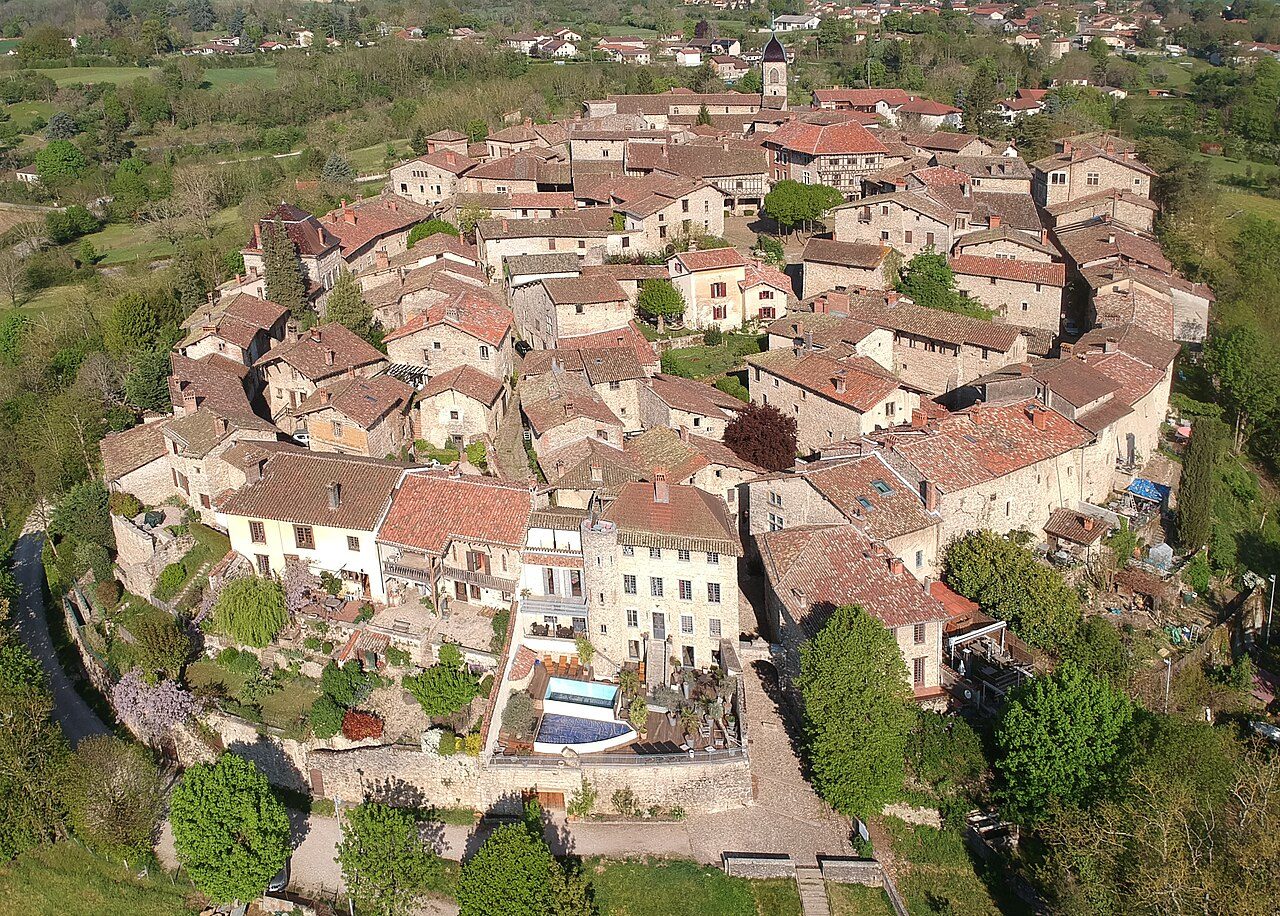
A walled weavers’ town on a hilltop near Lyon, cobbled end to end, with a liberty tree in the square and sugar galette in every oven.
Why go
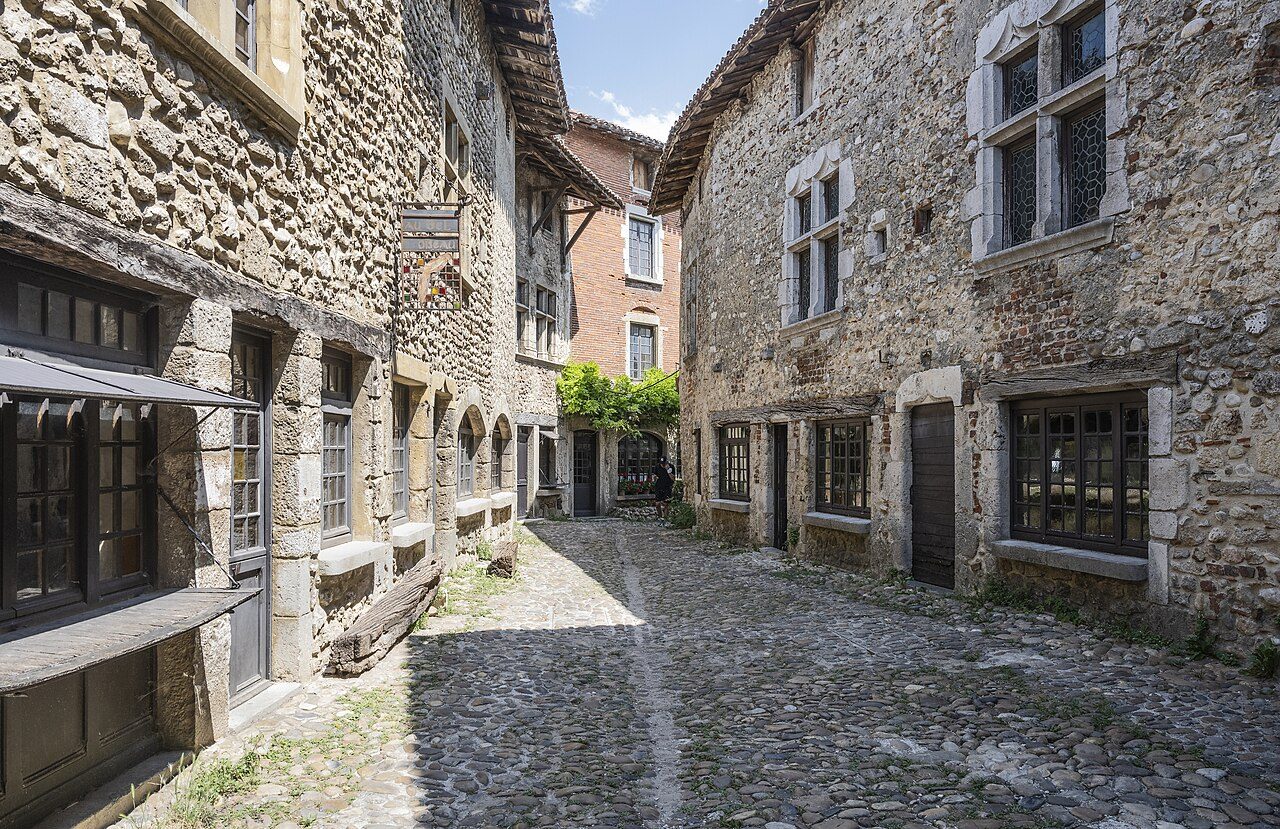
Pérouges is what film-makers reach for when they need the seventeenth century without building a set. The whole walled town fits on a small hill above the Ain plain: river-stone cobbles, half-timbered houses, a fortified church that is part of the rampart. It almost died in the nineteenth century, which is why it survived intact. Come in the evening, after the day-trippers from Lyon have gone, and you will have the lanes to yourself.
History
People were living on this hill long before the town: archaeologists have found traces going back to the Chalcolithic. Local tradition says the name comes from settlers from Perugia in Italy, a story better treated as legend than as history. What is certain is that by the twelfth and thirteenth centuries Pérouges was a fortified market town on the border between rival powers, and its inhabitants won charters of liberties from their lords.
The town changed hands between the Dauphiné and Savoy in the fourteenth century before settling under Savoy. In 1468 troops of Louis XI, coming from the Dauphiné, attacked it; behind its double wall Pérouges held out, and a plaque over the lower gate still celebrates the victory. In 1601, by the treaty of Lyon, the Bresse and Bugey, Pérouges included, became French.
For three centuries the town lived from weaving, above all hemp. When that trade died in the nineteenth century, and new roads and the railway passed it by, the population drained away; by 1911 only a few dozen people still lived inside the walls and houses were being pulled down for their stone.
That year a committee for the defence of old Pérouges was founded in Lyon. It bought and restored houses, brought craftsmen back and turned the ruins of the Maison des Princes into its headquarters. Film crews followed: Monsieur Vincent in 1947 and The Three Musketeers in 1961 among them. Today the town is a member of Les Plus Beaux Villages de France, and still very much lived in.
Member of the association Les Plus Beaux Villages de France. The Plus Beaux Villages de France by train →
What to see
Place du Tilleul
The central square is named after the lime tree planted as a tree of liberty just after the Revolution. Around it stand the finest timber-framed and corbelled houses of the town, including an old inn that has served as a film set more than once.
The fortified church
Sainte-Marie-Madeleine is built into the town wall, and it shows: high, nearly blind outer walls that took part in the defence of the town, and a wall-walk along the top of one aisle. Inside, the restored furnishings make it a small museum of religious art.
Porte d’En-Bas and the rue des Rondes
Enter by the lower gate, look up for the plaque recalling the siege of 1468, then follow the rue des Rondes, which circles inside the walls past old weavers’ houses. The river-stone cobbles are hard on thin soles; the views out over the Ain plain towards the Bugey hills make up for it.
Maison des Princes and the town museum
Rebuilt from ruins by the preservation committee from 1952, the Maison des Princes is the committee’s home, with the town museum, a watchtower and a garden alongside. It is the place to understand how Pérouges was nearly lost and then saved.
Galette de Pérouges
A thin, buttery tart of flour, egg, lemon zest and a crust of sugar, best eaten warm, often in the square under the lime tree. It is the town’s signature, sold all over the old town, and you will smell it baking long before you see it.
Climate
Météo-France normals 1991-2020, station Amberieu (250 m, 14.2 km away). Sunshine: Amberieu station (14.2 km).
| Jan | Feb | Mar | Apr | May | Jun | Jul | Aug | Sep | Oct | Nov | Dec | |
|---|---|---|---|---|---|---|---|---|---|---|---|---|
| High °C | 6.5 | 8.4 | 13.5 | 17.1 | 20.9 | 25.0 | 27.5 | 27.3 | 22.4 | 17.1 | 10.8 | 7.0 |
| Low °C | -0.1 | 0.0 | 2.6 | 5.5 | 9.5 | 13.0 | 14.7 | 14.4 | 10.9 | 8.1 | 3.5 | 0.8 |
| Rain (mm) | 85 | 70 | 75 | 87 | 106 | 89 | 86 | 83 | 106 | 118 | 118 | 94 |
| Rain days | 11 | 10 | 10 | 10 | 11 | 10 | 8 | 8 | 9 | 11 | 11 | 12 |
| Sunshine (h) | 68 | 98 | 170 | 194 | 220 | 252 | 288 | 261 | 189 | 122 | 73 | 55 |
Timeline
- 1236? Inhabitants obtain a charter of liberties
- 1329 The Dauphins grant a first charter during their brief rule
- 1468 The town repels Louis XI’s troops from the Dauphiné
- 1601 Treaty of Lyon: Bresse and Bugey, and Pérouges, become French
- 1911 Committee for the defence of old Pérouges founded in Lyon
- 1961 The Three Musketeers filmed in the town
Uncertain or disputed
- The origin of the name from settlers from Perugia is a tradition, not established fact.
- The early charter dates differ between sources: one gives 1236 for the first communal liberties, another dwells on the Dauphins’ charters from 1329.
- Figures for the nineteenth-century depopulation vary widely between sources, so we give none.
Crowds: Busy at peaks. Sunny weekends from spring to autumn bring day visitors from Lyon by mid-morning; come on a weekday, or stay into the evening when the lanes empty. (editorial judgement)
Protected food & drink from here
AOP and IGP products whose official area includes this commune (INAO). Regional food: AOP & IGP →
Meat & charcuterie
- Volailles de l'Ain IGP · poultry
Wine
- Coteaux de l'Ain IGP
Festivals within 15 km
From the Ministry of Culture’s national list; it gives a season, not dates.
| Festival | Discipline | Season |
|---|---|---|
| Bourk’en’spray Bourg-en-Bresse | Visual & digital arts | 6 Sep – 31 Dec |
| Dagneux aime la musique Dagneux | Music | 21 Jun – 5 Sep |
| Festival d'humour Villieu-Loyes-Mollon | Theatre, dance & street arts | 6 Sep – 31 Dec |
| Festival du film d'animation Meximieux | Film | 6 Sep – 31 Dec |
| Les herbes folles Meximieux | Film | 1 Jan – 20 Jun |
| Les musicales du Parc des Oiseaux Villars-les-Dombes | Music | 21 Jun – 5 Sep |
| Leym'fest Leyment | Music | 21 Jun – 5 Sep |
| Printemps de Pérouges Saint-Vulbas | Music | 21 Jun – 5 Sep |
| Salon des auteurs de Meximieux Meximieux | Books & comics | 6 Sep – 31 Dec |
| Sylak Open Air Saint-Maurice-de-Gourdans | Music | 21 Jun – 5 Sep |
Also in this part of France
 3h43
Lake & mountains · Auvergne-Rhône-Alpes
Annecy
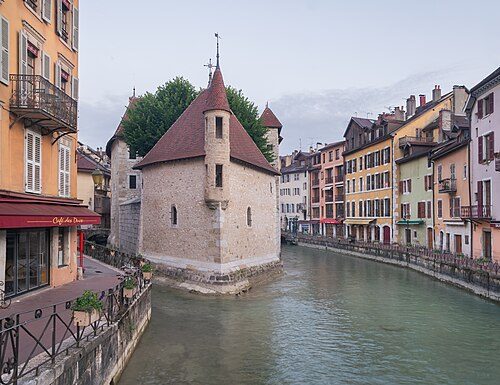
Canals, a prison on an island and a lake clear enough to swim in, with the Alps standing right at the end of the street.
 2h38
Village · Burgundy–Franche-Comté
Arbois
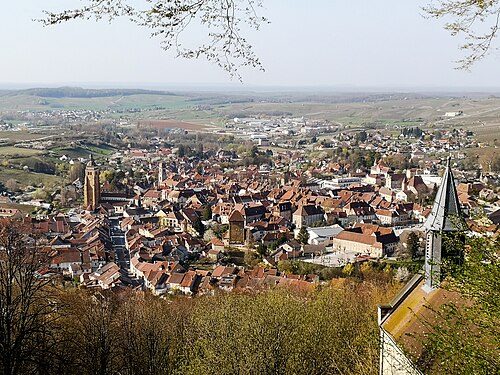
Pasteur’s home town, capital of Jura wine: vin jaune, a river running under houses, and a limestone gorge just beyond the last street.
 2h05
Town · Burgundy–Franche-Comté
Beaune
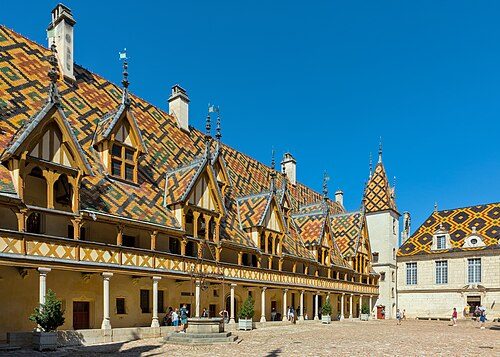
A walled wine town with the most famous roof in Burgundy, a medieval hospital for the poor, and the Côte’s great vineyards at the edge of town.
 5h32
Mountains · Auvergne-Rhône-Alpes
Chamonix-Mont-Blanc
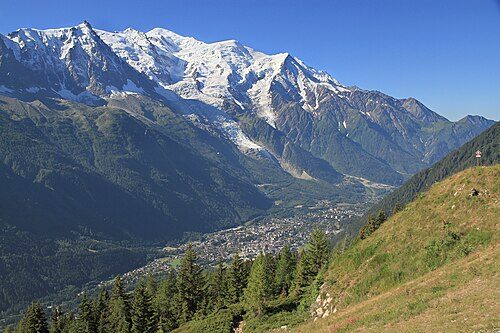
The valley where mountaineering was born: Mont Blanc over the rooftops, a glacier by rack railway, and a cable car to nearly 3,850 metres.
Sources
Original text. Train times computed from SNCF timetables (ODbL); climate Météo-France; products INAO; festivals Ministry of Culture. Methodology.