


Town · Île-de-France (beyond Paris) · Altitude 76 m
Fontainebleau
Seven centuries of French kings in one palace, wrapped in a vast forest of sandstone boulders, oaks and painters’ viewpoints.
Why go
Versailles is one king’s statement; Fontainebleau is a family home that every ruler from the twelfth century to Napoleon III altered, so you walk through the whole of French history room by room. And then you leave it for the forest: tens of thousands of hectares of oak, pine and sandstone boulders, with marked trails that start at the edge of town. A day here is half palace, half fresh air, which is exactly what Paris cannot give you.
History
The kings came for the hunting. A royal residence stood here by the twelfth century, and in 1169 the exiled archbishop of Canterbury, Thomas Becket, consecrated a chapel built by Louis VII. For the next three hundred years Fontainebleau was a hunting lodge in a royal forest, used and enlarged but not yet famous.
Francis I changed that. Back from captivity in Spain and in love with Italy, he rebuilt the château from the late 1520s and called in Italian artists. Rosso Fiorentino and then Primaticcio decorated the long gallery that bears the king’s name, mixing frescoes and stucco in a way no one in France had seen; the style they founded is known as the School of Fontainebleau. Henry II, Henry IV and their successors kept adding courtyards, wings and gardens, and Louis XIII was born here in 1601.
Napoleon, who called the palace ‘the true home of kings', refurnished it lavishly. He kept Pope Pius VII here under guard from 1812 to 1814, and in April 1814 it was here that he signed his abdication; on 20 April he said farewell to the Old Guard at the foot of the horseshoe staircase before leaving for Elba. Napoleon III and Eugénie were the last sovereigns to spend their summers here.
Meanwhile the forest found new admirers. From the 1830s, painters at nearby Barbizon, led by Théodore Rousseau, worked in the open air and fought logging in the old groves; the reserves created in 1853 and 1861 for their sake are among the earliest nature protections anywhere. The palace and park were inscribed by UNESCO in 1981.
UNESCO World Heritage: Palace and Park of Fontainebleau (1981)
What to see
Gallery of Francis I
The room that brought the Italian Renaissance to France: a long gallery decorated in the 1530s by Rosso Fiorentino, with frescoes framed by stucco nymphs, putti and garlands, above carved walnut panelling. Look for the salamander, Francis I’s emblem, and for the allegories of his reign hidden in the scenes.
Cour du Cheval Blanc and the horseshoe staircase
The vast entrance courtyard, also called the Cour des Adieux, is where Napoleon took leave of his Guard on 20 April 1814. The double horseshoe staircase on the main façade, rebuilt under Louis XIII, is the château’s signature: stand at the far end of the courtyard to take in the whole composition.
Napoleon’s apartments
The emperor’s bedroom, study and the small room associated with his abdication, furnished in the Empire style he ordered. Seeing the setting of 1814 makes the farewell in the courtyard below much more vivid. The throne room nearby, created for him from a former royal bedchamber, shows how carefully he dressed himself in the legitimacy of the kings.
The gardens and the Carp Pond
The formal Grand Parterre, the English garden and the pond with its little pavilion in the middle are free to wander. The canal, dug under Henry IV, runs far out into the park. Walk to the end of it and you are already halfway to the forest, with the palace roofs small behind you.
Fontainebleau forest
Around 25,000 hectares of oak, beech, pine and heath, scattered with sandstone boulders that draw climbers from all over the world. Many of the marked footpaths were first laid out in the 1840s by Claude-François Denecourt; the Gorges de Franchard and Gorges d’Apremont are classic walks. In 2012 it was the first French forest to receive the ‘Forêt d’Exception’ label.

Climate
Météo-France normals 1991-2020, station Fontainebleau_sapc (84 m, 1.7 km away). Sunshine: Melun station (22.9 km).
| Jan | Feb | Mar | Apr | May | Jun | Jul | Aug | Sep | Oct | Nov | Dec | |
|---|---|---|---|---|---|---|---|---|---|---|---|---|
| High °C | 7.2 | 8.7 | 12.9 | 16.6 | 20.1 | 23.6 | 26.3 | 26.2 | 21.9 | 16.6 | 10.9 | 7.6 |
| Low °C | 0.5 | 0.0 | 1.8 | 3.7 | 7.5 | 10.8 | 12.6 | 12.1 | 8.8 | 6.4 | 3.0 | 1.1 |
| Rain (mm) | 58 | 54 | 53 | 59 | 67 | 60 | 62 | 59 | 61 | 68 | 67 | 72 |
| Rain days | 12 | 11 | 9 | 10 | 10 | 9 | 8 | 8 | 8 | 10 | 12 | 13 |
| Sunshine (h) | 60 | 83 | 143 | 188 | 216 | 226 | 235 | 225 | 180 | 118 | 68 | 54 |
Timeline
- 1169 Thomas Becket consecrates the chapel built by Louis VII
- 1528 Work begins on what becomes the Gallery of Francis I
- 1601 Birth of the future Louis XIII at the château
- 1812 Pope Pius VII held at Fontainebleau until 1814
- 1814 Napoleon abdicates; farewell to the Old Guard on 20 April
- 1861 Decree enlarging the forest’s ‘artistic reserve’ after the Barbizon painters’ campaign
- 1981 Palace and park inscribed on the UNESCO World Heritage List
Uncertain or disputed
- Sources give Napoleon’s abdication as 4 April or 6 April 1814 (a conditional act, then an unconditional one); we say ‘April 1814'.
- The area of the forest depends on what is counted (the whole massif, public forest only, or the state forest); about 25,000 hectares is the usual figure for the whole massif.
- Some accounts date Francis I’s rebuilding from 1527, others from 1528.
Crowds: Busy at peaks. The château is busiest on weekends and during school holidays, and forest car parks fill on sunny Sundays; a weekday morning gives you both at their quietest. (editorial judgement)
Protected food & drink from here
AOP and IGP products whose official area includes this commune (INAO). Regional food: AOP & IGP →
Cheese
- Brie de Meaux AOP · soft bloomy-rind cheese
- Brie de Melun AOP · soft bloomy-rind cheese
Festivals within 15 km
From the Ministry of Culture’s national list; it gives a season, not dates.
| Festival | Discipline | Season |
|---|---|---|
| Au Bon Coin Thomery | Theatre, dance & street arts | 21 Jun – 5 Sep |
| Au Coin des Rues Moret-Loing-et-Orvanne | Theatre, dance & street arts | 1 Jan – 20 Jun |
| Branche & Ciné Fontainebleau | Film | 21 Jun – 5 Sep |
| Contes en Maisons Villages des Seine et Marne | Theatre, dance & street arts | 1 Jan – 20 Jun |
| Festi'Val en Seine Saint-Mammès | Music | 21 Jun – 5 Sep |
| Festival de l'histoire de l'art Fontainebleau | Visual & digital arts | 21 Jun – 5 Sep |
| Festival de l'humour de Moret-sur-Loing Moret-Loing-et-Orvanne | Theatre, dance & street arts | 6 Sep – 31 Dec |
| Festival Django Reinhardt Fontainebleau | Music | 21 Jun – 5 Sep |
| Jazz au Théâtre Fontainebleau | Music | 6 Sep – 31 Dec |
| Les Rencontres Internationales de la Harpe en Ile-de-France Moret-Loing-et-Orvanne | Music | 1 Jan – 20 Jun |
| L’Enfant et le 7ème art Fontainebleau | Film | 1 Jan – 20 Jun |
| Paradisio Moret-Loing-et-Orvanne | Film | 21 Jun – 5 Sep |
| Série Series - le festival des séries européennes Fontainebleau | Film | 21 Jun – 5 Sep |
Also in this part of France
 1h21
Town · Île-de-France (beyond Paris)
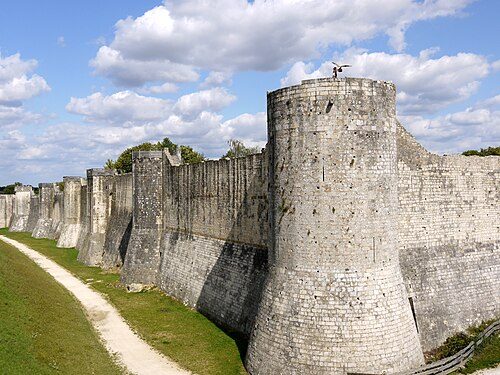
Provins
The great medieval fair town of Champagne, still walled, with a twelfth-century keep, merchants’ cellars and tunnels under the streets.
 2h17
Village · Burgundy–Franche-Comté
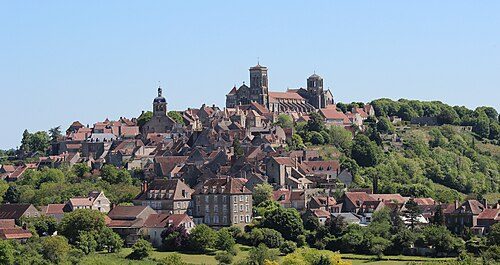
Vézelay
One street climbing a Burgundian hill to a Romanesque basilica where, on the summer solstice, sunlight lays a path of light down the nave.
 1h32
Town · Hauts-de-France
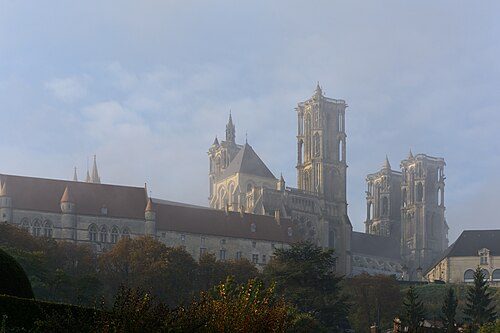
Laon
A medieval town on a ridge above the Picardy plain, with a Gothic cathedral whose towers are guarded by sixteen stone oxen.
 1h56
City · Centre–Val de Loire
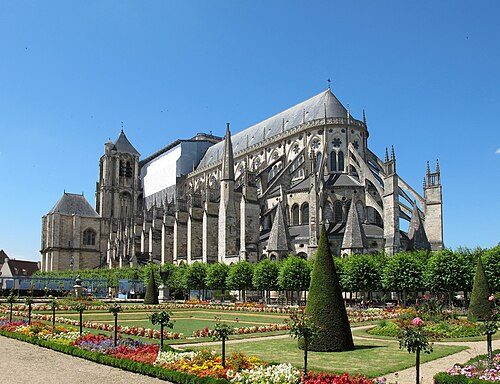
Bourges
A Gothic cathedral with no transept and five great portals, a merchant’s palace, and market gardens on the marshes at the edge of town.
Sources
- Château de Fontainebleau – official site
- Wikipedia (en) – Palace of Fontainebleau
- Wikipédia (fr) – Forêt de Fontainebleau
- Ministère de la Culture – Château de Fontainebleau
- UNESCO World Heritage Centre – Palace and Park of Fontainebleau
Original text. Train times computed from SNCF timetables (ODbL); climate Météo-France; products INAO; festivals Ministry of Culture. Methodology.