

City · Occitanie · Altitude 166 m
Albi
A red-brick episcopal city on the Tarn: a fortress-cathedral painted inside from floor to vault, and the world’s largest Toulouse-Lautrec collection.
Why go
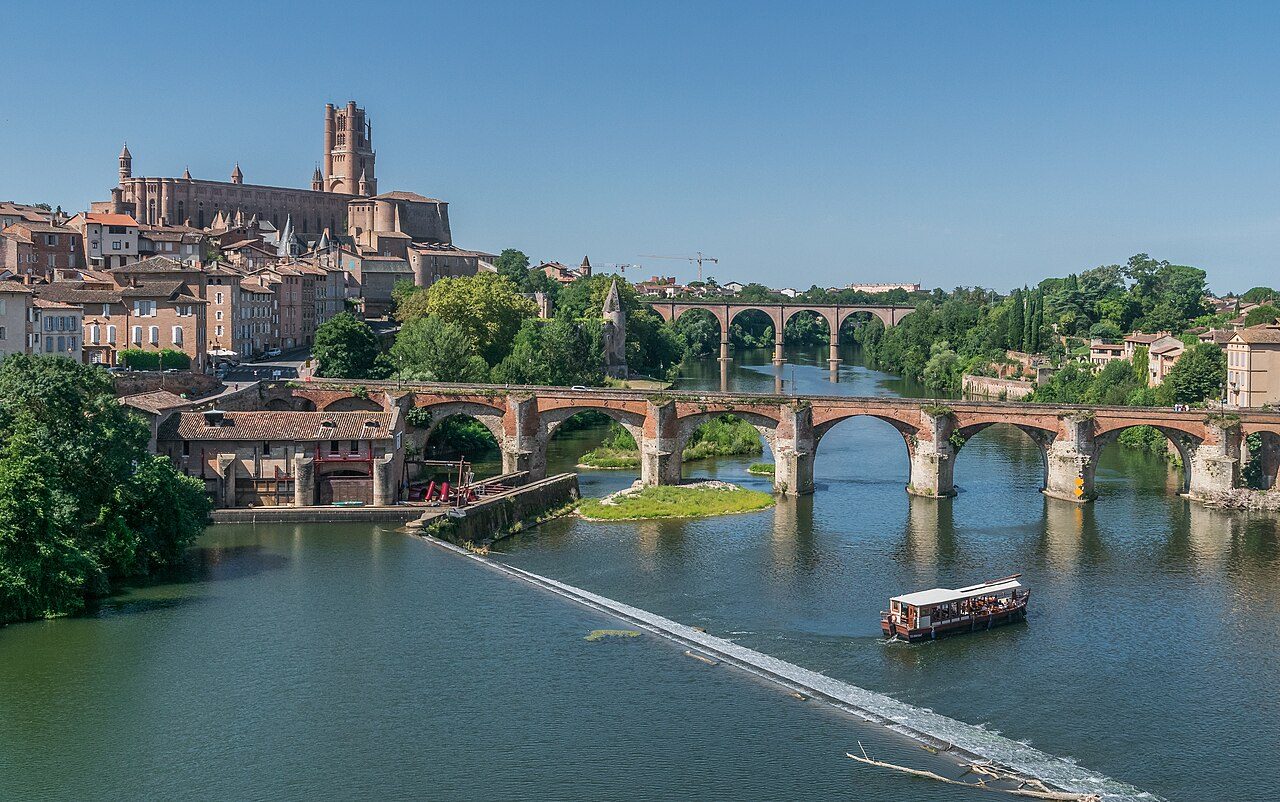
Albi is built of brick, and at sunset the whole town glows red above the river. Its cathedral looks like a fortress from outside and a jewel box within, every surface painted. Then there is Toulouse-Lautrec, born here, whose Paris of cabarets and brothels hangs in the bishops’ palace of his home town: the perfect way to see Montmartre without going near it. Small enough to walk, lively enough to stay a few days.
History
Albi stood at a crossing of the Tarn long before its first stone bridge, the Pont-Vieux, was built in the eleventh century; it is usually dated to the 1030s or 1040s and is still in use. Toll revenue and trade along the river helped the town grow, and the bishops became its lords.
The town gave its name to a whole heresy. In the twelfth and thirteenth centuries Cathar Christianity spread through Languedoc, and the crusade preached against it from 1209 became known as the Albigensian Crusade, even though Albi itself was not its centre. The bishops who emerged victorious made sure their power was visible.
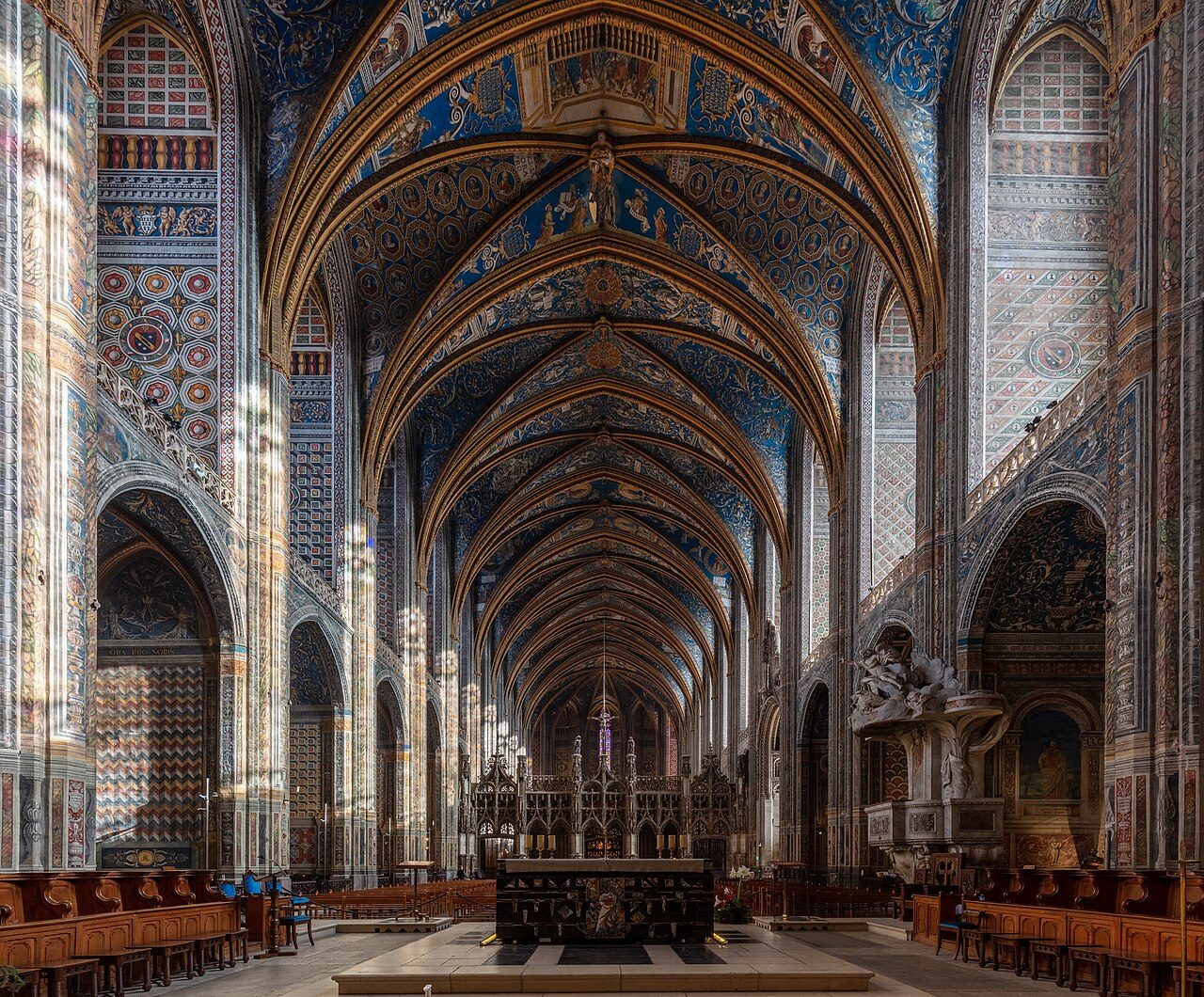
In 1282 Bishop Bernard de Castanet began a new cathedral in brick, plain-walled and massive as a fortress, and the fortified bishops’ palace, the Palais de la Berbie, grew beside it. The cathedral of Sainte-Cécile was consecrated in 1480. Its later bishops filled it with colour: a huge Last Judgement at the west end at the end of the fifteenth century, a lace-like stone rood screen, and between 1509 and 1512 vaults painted by artists from northern Italy.
The Renaissance brought new wealth from pastel, the woad plant that gave Europe its blue dye before indigo, and merchants built brick mansions such as the Hôtel de Reynès. In 1864 Henri de Toulouse-Lautrec was born into an aristocratic Albi family; after his death his mother gave much of his work to the town, and the museum opened in the Palais de la Berbie in 1922. The Episcopal City of Albi was inscribed by UNESCO in 2010.
UNESCO World Heritage: Episcopal City of Albi (2010)
What to see
Sainte-Cécile cathedral
From outside, a sheer cliff of brick with a 78-metre bell tower and a single flamboyant stone porch. Inside, an explosion of colour: painted blue-and-gold vaults, a vast Last Judgement fresco and a stone rood screen and choir enclosure peopled with statues. Few churches anywhere show so plainly the contrast between power and splendour.
Toulouse-Lautrec Museum, Palais de la Berbie
The fortified bishops’ palace now holds the largest collection of Toulouse-Lautrec’s work anywhere: early paintings from his Albi youth, the Moulin Rouge and brothel scenes, and his famous posters. The visit ends in the palace’s formal garden above the Tarn, with one of the best views of the river and bridges.
The Pont-Vieux and the Tarn banks
The eleventh-century bridge, still carrying traffic, is the place to see the whole episcopal city rising above the water. Cross it and walk down to the riverbanks on the far side, especially in the late afternoon, when the brick turns deep red.
Saint-Salvi collegiate church and cloister
Older than the cathedral and part of the UNESCO site, this church mixes Romanesque stone and Gothic brick, a record of how building changed here. Its small cloister, just off a busy shopping street, is one of the calmest spots in town.
The old town and its mansions
Lanes of half-timbered houses filled with brick in herringbone patterns lead to the Renaissance mansions of the woad merchants, such as the Hôtel de Reynès with its courtyard and carved busts. Look out also for the covered market hall near the cathedral, a fine example of iron-and-glass architecture.
Climate
Météo-France normals 1991-2020, station Albi (172 m, 2.8 km away). Sunshine: Albi station (2.8 km).
| Jan | Feb | Mar | Apr | May | Jun | Jul | Aug | Sep | Oct | Nov | Dec | |
|---|---|---|---|---|---|---|---|---|---|---|---|---|
| High °C | 9.7 | 11.4 | 15.3 | 18.1 | 22.0 | 26.1 | 28.8 | 29.1 | 24.9 | 20.0 | 13.5 | 10.3 |
| Low °C | 1.9 | 1.7 | 4.2 | 6.7 | 10.5 | 14.2 | 16.1 | 16.1 | 12.6 | 9.6 | 5.2 | 2.3 |
| Rain (mm) | 61 | 49 | 55 | 80 | 79 | 63 | 46 | 49 | 57 | 65 | 66 | 66 |
| Rain days | 11 | 9 | 9 | 10 | 9 | 7 | 6 | 6 | 7 | 9 | 10 | 11 |
| Sunshine (h) | 90 | 120 | 175 | 188 | 219 | 247 | 276 | 263 | 216 | 156 | 96 | 88 |
Timeline
- c. 1035? The Pont-Vieux is built across the Tarn
- 1209 The crusade against the Cathars, later called the Albigensian Crusade, begins
- 1282 Bishop Bernard de Castanet begins the brick cathedral
- 1480 Sainte-Cécile is consecrated on 23 April
- 1509 North Italian painters begin the cathedral vaults (completed 1512)
- 1864 Birth of Henri de Toulouse-Lautrec in Albi
- 1922 The Toulouse-Lautrec Museum opens in the Palais de la Berbie
- 2010 The Episcopal City of Albi is inscribed by UNESCO
Uncertain or disputed
- The Pont-Vieux is usually dated to 1035-1042; one source speaks of a first bridge as early as the 10th century.
- Sainte-Cécile is often called the largest brick building in the world; this is a claim we could not verify.
- Sources differ on whether the founding gift to the museum came from the painter’s mother alone or from both his parents.
Crowds: Busy at peaks. July and August afternoons are the busiest, especially around the cathedral; mornings, early evening and the spring and autumn months are much quieter. (editorial judgement)
Protected food & drink from here
AOP and IGP products whose official area includes this commune (INAO). Regional food: AOP & IGP →
Meat & charcuterie
- Canard à foie gras du Sud-Ouest IGP · meat product
- Jambon de Bayonne IGP · cured meat
- Porc du Sud-Ouest IGP · pork
- Veau d'Aveyron et du Ségala IGP · beef
Wine
- Comté Tolosan IGP
- Côtes du Tarn IGP
Festivals within 15 km
From the Ministry of Culture’s national list; it gives a season, not dates.
| Festival | Discipline | Season |
|---|---|---|
| Albi Jazz Festival Albi | Music | – |
| ArteTango Albi | Theatre, dance & street arts | 21 Jun – 5 Sep |
| Association Les Petites Choses Cagnac-Les Mines | Theatre, dance & street arts | 21 Jun – 5 Sep |
| Association Triple A Rivieres | Music | 21 Jun – 5 Sep |
| Complot sur le campus Albi | Theatre, dance & street arts | – |
| Concours de guitare classqiue espagnole et flamenca en pays tarnais Albi | Music | 1 Jan – 20 Jun |
| Equinocci Albi | Theatre, dance & street arts | 6 Sep – 31 Dec |
| Festival Acthea Albi | Theatre, dance & street arts | 1 Jan – 20 Jun |
| Festival Albi, place(s) aux artistes Albi | Theatre, dance & street arts | 21 Jun – 5 Sep |
| Festival du film francophone d'Albi - Les Oeillades Albi | Film | 6 Sep – 31 Dec |
| Festival Pause guitare à Albi Albi | Music | 21 Jun – 5 Sep |
| Festival Tons voisins Albi Albi | Music | 1 Jan – 20 Jun |
| Le Festival des petits cailloux Albi | Theatre, dance & street arts | 6 Sep – 31 Dec |
| Les Enfantillades Albi | Theatre, dance & street arts | 1 Jan – 20 Jun |
| Nect'arts festival Carmaux | Theatre, dance & street arts | 21 Jun – 5 Sep |
| Rencontres Albi flamenca Albi | Music | 1 Jan – 20 Jun |
+ 4 — Festivals →
Also in this part of France
 6h37
Village · Occitanie
Conques
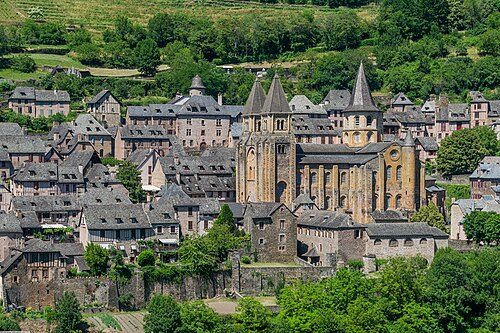
A slate-roofed village hidden in a wooded gorge, built around a Romanesque abbey church, a famous Last Judgement and a golden reliquary.
 5h24
Town · Occitanie
Carcassonne
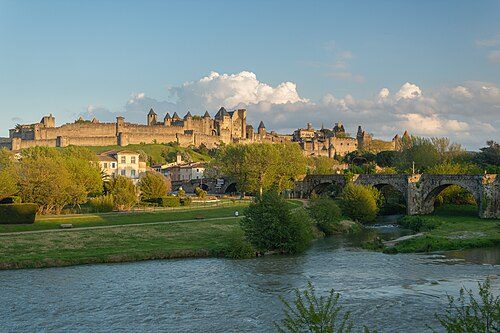
A medieval fortress city with two rings of walls and dozens of towers on a hill above the Aude, rescued from demolition in the 1850s.
 4h53
Town · Nouvelle-Aquitaine
Sarlat-la-Canéda
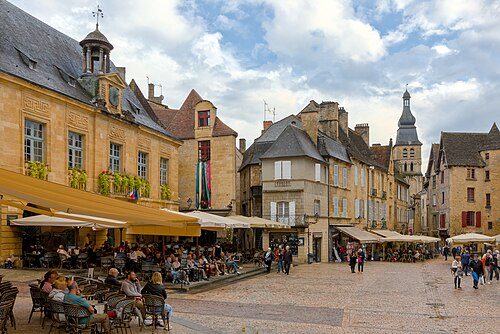
The golden-stone capital of the Périgord Noir: Gothic and Renaissance mansions, stone-slab roofs and one of France’s great food markets.
 6h18
Coast · Occitanie
Collioure
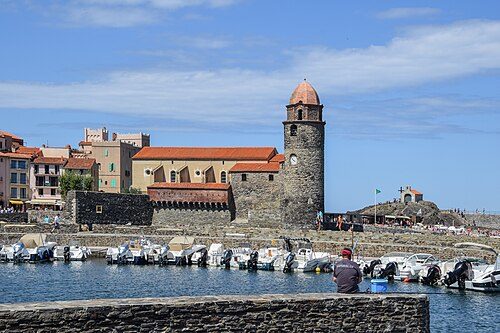
A Catalan fishing port where the Pyrenees meet the Mediterranean, with a sea-washed church tower and the light that gave birth to Fauvism.
Sources
- Wikipedia (en) – Albi Cathedral
- Wikipédia (fr) – Albi
- Wikipedia (en) – Musée Toulouse-Lautrec
- Le Routard – Albi, en rouge majesté
- French Moments – Episcopal City of Albi
- UNESCO World Heritage Centre – Episcopal City of Albi
Original text. Train times computed from SNCF timetables (ODbL); climate Météo-France; products INAO; festivals Ministry of Culture. Methodology.