

Town · Nouvelle-Aquitaine · Altitude 156 m
Sarlat-la-Canéda
The golden-stone capital of the Périgord Noir: Gothic and Renaissance mansions, stone-slab roofs and one of France’s great food markets.
Why go
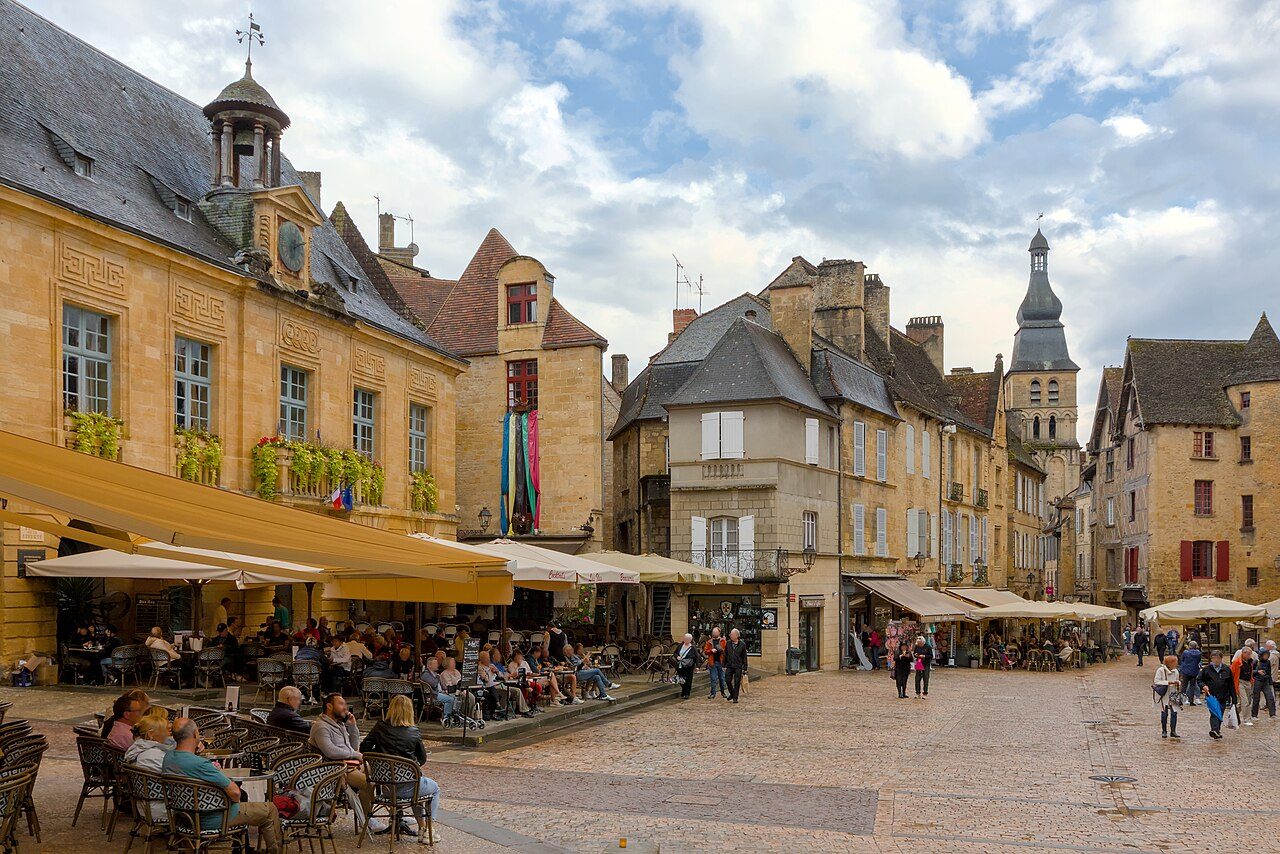
Sarlat is the town the French chose to save first. Its medieval and Renaissance centre was the first place restored under the 1962 Malraux law, and the result is a whole town of ochre limestone, steep stone roofs and carved doorways, with very little modern intrusion. Add a Saturday market heaped with walnuts, mushrooms and duck, and the Dordogne valley’s castles a few kilometres away, and it is everything Paris is not: slow, rural and built around the table.
History
Sarlat grew around a Benedictine abbey whose origins are lost in legend; historians place its foundation in the first half of the ninth century, in Carolingian times. The abbey prospered, the town grew up at its gates, and in 1317-1318 Pope John XXII made Sarlat the seat of a new bishopric, with the abbey church as its cathedral.
The Hundred Years’ War brought Sarlat into English hands under the treaty of Brétigny in 1360, but about ten years later, as Bertrand du Guesclin pushed the English back, the town returned to the French king. After the war ended in the 1450s, a long period of prosperity began: merchants, lawyers and churchmen built the stone town houses, with towers, galleries and mullioned windows, that still line the streets.
The most famous Sarladais of that age was Étienne de La Boétie, born here in 1530, magistrate and author of the ‘Discourse on Voluntary Servitude', and the close friend whose early death Montaigne mourned in his Essays. His family’s Renaissance house faces the cathedral.
Then the town fell out of the main currents of history and, crucially, was never rich enough to rebuild. By the twentieth century the old centre was crumbling. The Malraux law of 4 August 1962 created protected historic districts, and Sarlat, with its sector established in 1964, became the first town where the law was put into practice. Decades of restoration followed, including the conversion of the former church of Sainte-Marie into a covered market by the architect Jean Nouvel, who grew up in Sarlat, around 2000.
What to see
Place de la Liberté and the old centre
The main square, lined with honey-coloured façades and dominated by the bell tower of Sainte-Marie, opens onto lanes of mansions with turrets and carved doorways. Cross west of the main street, the rue de la République, into the quieter half of town, and look up: the steep roofs are covered in heavy limestone slabs.
Saint-Sacerdos cathedral and the Lanterne des Morts
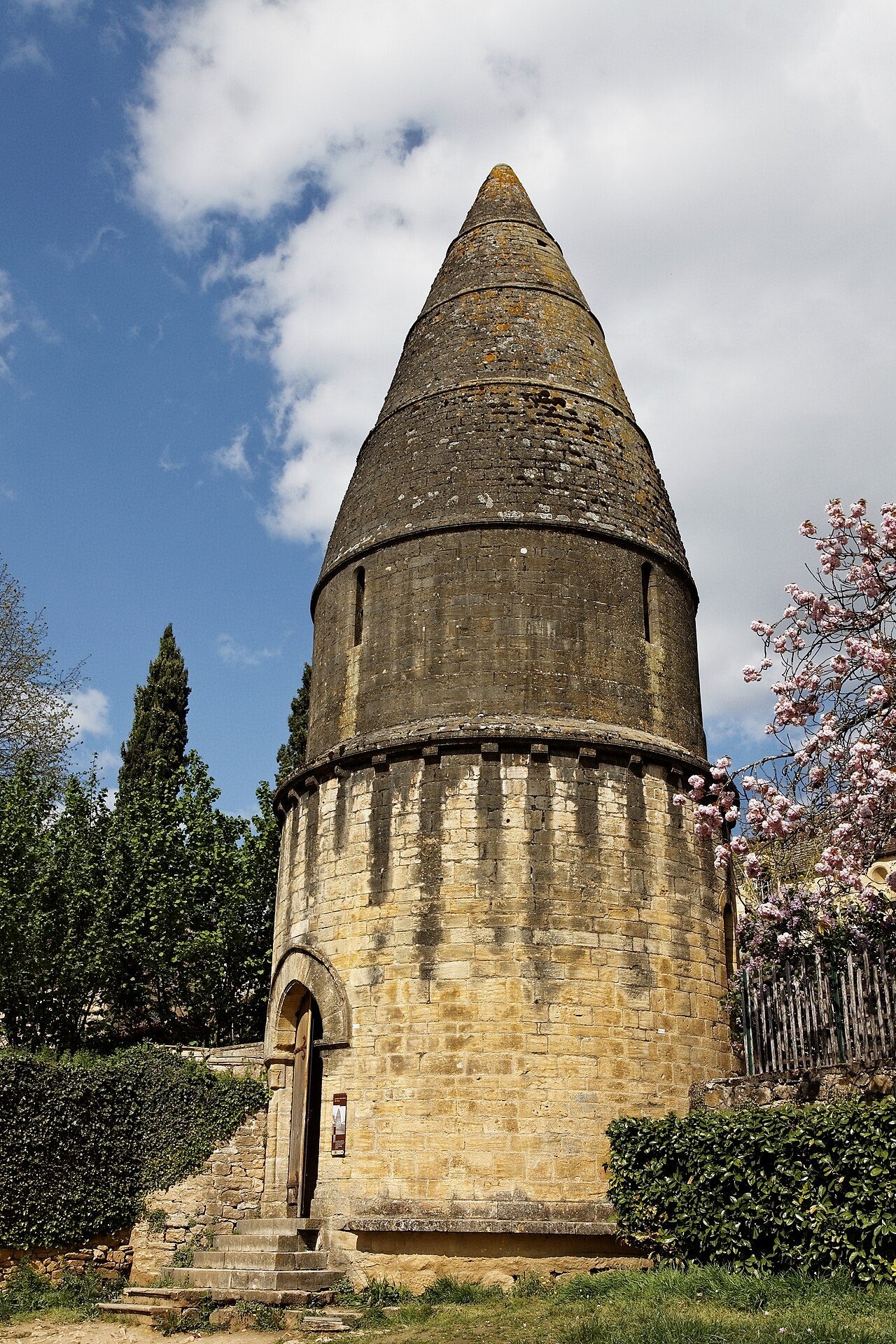
The former abbey church became a cathedral in the fourteenth century and was largely rebuilt later, keeping a Romanesque bell tower. Behind its east end, in the old burial ground, stands the Lanterne des Morts, a twelfth-century cylindrical tower with a conical stone roof whose original purpose is still a mystery.
Maison de La Boétie
Opposite the cathedral, the Renaissance house where Étienne de La Boétie was born in 1530: a tall façade with richly carved windows and a steep gable, one of the finest examples of the town’s sixteenth-century architecture. Seen from the square, it sums up Sarlat’s golden age.
The Saturday market and the covered market
On Saturdays the whole centre fills with stalls of walnuts, cheeses, mushrooms, foie gras and, in winter, black truffles. The covered market is housed in the former church of Sainte-Marie, converted by Jean Nouvel; its bell tower has a panoramic lift with a view over the roofs.
The Dordogne valley around Sarlat
A short drive south, the Dordogne river winds beneath cliff villages and castles such as Beynac and Castelnaud, which faced each other across the water in the Hundred Years’ War, and La Roque-Gageac built against the rock. Sarlat makes the obvious base for exploring them.
Climate
Météo-France normals 2004-2020, station Salignac-Eyvigues (276 m, 12.7 km away). Sunshine: Gourdon station (21.5 km).
| Jan | Feb | Mar | Apr | May | Jun | Jul | Aug | Sep | Oct | Nov | Dec | |
|---|---|---|---|---|---|---|---|---|---|---|---|---|
| High °C | 8.3 | 10.0 | 13.9 | 17.9 | 20.7 | 24.6 | 27.0 | 26.6 | 23.5 | 18.8 | 12.6 | 9.2 |
| Low °C | 2.1 | 1.8 | 4.5 | 7.4 | 10.1 | 13.4 | 15.1 | 14.5 | 12.0 | 9.6 | 5.5 | 2.5 |
| Rain (mm) | 87 | 68 | 82 | 88 | 80 | 80 | 54 | 52 | 66 | 73 | 87 | 90 |
| Rain days | 13 | 10 | 13 | 11 | 11 | 9 | 7 | 8 | 8 | 10 | 12 | 12 |
| Sunshine (h) | 92 | 120 | 170 | 180 | 214 | 242 | 265 | 252 | 209 | 149 | 95 | 90 |
Timeline
- 9th c.? A Benedictine abbey is founded, around which the town grows
- 1317? Pope John XXII creates the bishopric of Sarlat
- 1360 The treaty of Brétigny hands Sarlat to the English
- 1530 Birth of Étienne de La Boétie
- 1962 The Malraux law on protected historic districts
- 1964 Sarlat becomes the first town where the Malraux law is applied
- 1965 Sarlat and La Canéda merge into one commune
Uncertain or disputed
- The date and founder of the abbey are uncertain; tradition links it to Pepin I of Aquitaine in the first half of the 9th century.
- The creation of the bishopric is dated 1317 in some sources and 1318 in others (the papal decision and its implementation).
- The date of the church of Sainte-Marie and of its conversion into a market (2000 or 2001) vary between sources.
Crowds: Very busy in season. July, August and Saturday mornings are very crowded; come midweek in spring or autumn, or in winter for the truffle season, and walk the lanes in the evening when they empty. (editorial judgement)
Protected food & drink from here
AOP and IGP products whose official area includes this commune (INAO). Regional food: AOP & IGP →
Meat & charcuterie
- Agneau du Périgord IGP · lamb
- Agneau du Quercy IGP · lamb
- Canard à foie gras du Sud-Ouest IGP · meat product
- Chapon du Périgord IGP · poultry
- Jambon de Bayonne IGP · cured meat
- Porc du Limousin IGP · pork
- Porc du Sud-Ouest IGP · pork
- Poularde du Périgord IGP · poultry
- Poulet du Périgord IGP · poultry
- Veau du Limousin IGP · beef
Fruit, vegetables & nuts
- Fraise du Périgord IGP · red fruit
- Noix du Périgord AOP · nuts
Butter, oil, honey & more
- Huile de noix du Périgord AOP · oil
Wine
- Atlantique IGP
Festivals within 15 km
From the Ministry of Culture’s national list; it gives a season, not dates.
| Festival | Discipline | Season |
|---|---|---|
| Festival des Arts en Folie Sarlat-la-Canéda | Theatre, dance & street arts | 1 Jan – 20 Jun |
| Festival du Film de Sarlat Sarlat-la-Canéda | Film | 6 Sep – 31 Dec |
| Les Jeux du Théâtre Sarlat-la-Canéda | Theatre, dance & street arts | 21 Jun – 5 Sep |
| Salon du Livre Jeunesse Sarlat-la-Canéda | Books & comics | 1 Jan – 20 Jun |
Also in this part of France
 6h37
Village · Occitanie
Conques
A slate-roofed village hidden in a wooded gorge, built around a Romanesque abbey church, a famous Last Judgement and a golden reliquary.
 2h44
Village · Nouvelle-Aquitaine
Saint-Émilion
A honey-stone wine town tumbling into a hollow of the limestone, with a church carved out of the rock beneath its steep lanes.
 6h02
City · Occitanie
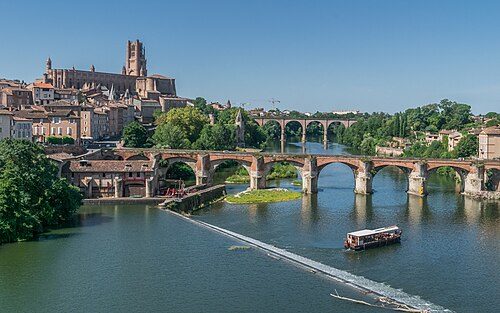
Albi
A red-brick episcopal city on the Tarn: a fortress-cathedral painted inside from floor to vault, and the world’s largest Toulouse-Lautrec collection.
 5h24
Town · Occitanie
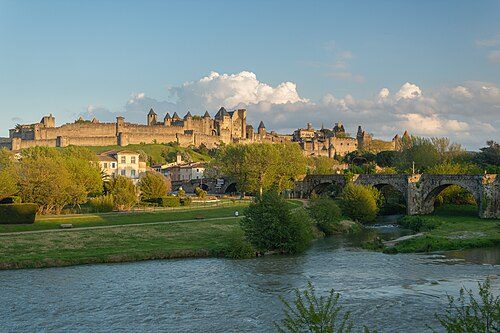
Carcassonne
A medieval fortress city with two rings of walls and dozens of towers on a hill above the Aude, rescued from demolition in the 1850s.
Sources
- Wikipédia (fr) – Sarlat-la-Canéda
- Dordogne Périgord Tourisme – Sarlat, Ville d’Art et d’Histoire
- Actu-Juridique – Quatre raisons inédites de visiter Sarlat
- Nouvelle-Aquitaine Tourisme – The markets of Sarlat
- Wikipedia (en) – Étienne de La Boétie
Original text. Train times computed from SNCF timetables (ODbL); climate Météo-France; products INAO; festivals Ministry of Culture. Methodology.