


Town · Occitanie · Altitude 104 m
Carcassonne
A medieval fortress city with two rings of walls and dozens of towers on a hill above the Aude, rescued from demolition in the 1850s.
Why go
Nothing in Paris prepares you for the first sight of the Cité: a whole hilltop of walls, towers and pointed roofs rising above vineyards and the river. It is a real medieval fortress, given a nineteenth-century romantic finish, and it is the best place in Europe to understand how a town was defended. Then cross the old bridge to the Bastide, the living lower town, with its square, its markets and the Canal du Midi gliding past: two cities for the price of one.
History
A Gaulish hill settlement became a fortified Roman town, and parts of its late Roman walls survive inside the medieval ones. After the Visigoths and the Franks, Carcassonne passed in the eleventh and twelfth centuries to the Trencavel family, viscounts who built the Château Comtal and in 1096 began the basilica of Saint-Nazaire with the blessing of Pope Urban II.
The Trencavels ruled lands where Cathar dualist Christianity had spread, and in 1209 the crusade launched by the papacy against the Cathars and their protectors reached the city. The siege began on 1 August; on 15 August the young viscount Raymond-Roger Trencavel surrendered and died in captivity a few months later. Simon de Montfort took his place, and in the following decades the city passed to the French crown.
The kings turned Carcassonne into a frontier fortress facing Aragon, adding the outer wall and strengthening the inner one, and in the late 1240s a new town, the Bastide Saint-Louis, was laid out on the other bank of the Aude for the inhabitants of the suburbs. After the Treaty of the Pyrenees moved the border south in 1659, the Cité lost its purpose and slowly decayed, while the Bastide prospered from the cloth trade.
In 1849 the government decided to demolish the fortifications. A local scholar, Jean-Pierre Cros-Mayrevieille, and the inspector of historic monuments Prosper Mérimée campaigned to save them, and from 1853 the architect Viollet-le-Duc led a restoration that lasted decades. His pointed slate roofs, more northern than Languedocian, are still debated. UNESCO inscribed the Cité in 1997.
UNESCO World Heritage: Historic Fortified City of Carcassonne (1997)
What to see
The ramparts and the lices
Two concentric walls, about three kilometres in all with some fifty towers, enclose the Cité. Between them runs the ‘lices', a grassy corridor where attackers who breached the outer wall would have been trapped. Walk it all the way round at your own pace: it is the best way to understand the defences, and the quietest part of the Cité.
Château Comtal and the wall walk
The Trencavels’ castle, a fortress within the fortress with its own moat and towers. The visit continues along a stretch of the inner wall walk, with wooden hoardings rebuilt by Viollet-le-Duc and views over the lices, the Bastide and, on clear days, the Pyrenees.
Basilica of Saint-Nazaire
A Romanesque nave leading to a luminous Gothic choir and transept, filled with stained glass, some of it from the thirteenth and fourteenth centuries. Look for the two rose windows facing each other across the transept and the carved stone panel known as the ‘siege stone', traditionally said to show the siege of Toulouse of 1218.
The Pont-Vieux and the Bastide Saint-Louis
The medieval stone bridge over the Aude links the Cité to the lower town, a grid of streets laid out in the thirteenth century around the Place Carnot and its fountain. It is where Carcassonnais actually live and shop, and from its riverbanks the Cité looks most like a fairy tale.
The Canal du Midi
Pierre-Paul Riquet’s seventeenth-century canal, a UNESCO World Heritage site in its own right, passes along the edge of the Bastide next to the station. Its towpath, shaded by plane trees, makes an easy walk or bike ride out of town between locks and fields.

Climate
Météo-France normals 1991-2020, station Carcassonne (128 m, 4.7 km away). Sunshine: Carcassonne station (4.7 km).
| Jan | Feb | Mar | Apr | May | Jun | Jul | Aug | Sep | Oct | Nov | Dec | |
|---|---|---|---|---|---|---|---|---|---|---|---|---|
| High °C | 10.0 | 11.4 | 14.9 | 17.7 | 21.4 | 25.9 | 28.8 | 28.9 | 24.8 | 19.7 | 13.9 | 10.7 |
| Low °C | 3.5 | 3.5 | 5.9 | 8.1 | 11.6 | 15.1 | 17.3 | 17.3 | 14.1 | 11.3 | 6.9 | 4.2 |
| Rain (mm) | 66 | 47 | 58 | 71 | 63 | 47 | 30 | 40 | 48 | 63 | 70 | 61 |
| Rain days | 10 | 8 | 8 | 9 | 8 | 6 | 5 | 5 | 6 | 7 | 9 | 8 |
| Sunshine (h) | 95 | 122 | 174 | 192 | 220 | 248 | 282 | 268 | 216 | 152 | 105 | 95 |
Timeline
- 1096 Construction of the basilica of Saint-Nazaire authorised, blessed by Pope Urban II
- 1209 Siege by the Albigensian crusaders; Raymond-Roger Trencavel surrenders on 15 August
- 1247 Carcassonne is annexed to the kingdom of France; the Bastide is founded around this time
- 1659 The Treaty of the Pyrenees moves the border south; the Cité loses its military role
- 1849 Government decision to demolish the walls, later reversed
- 1853 Viollet-le-Duc’s restoration begins
- 1997 Inscribed on the UNESCO World Heritage List
Uncertain or disputed
- The founding date of the Bastide Saint-Louis is given as 1247 or 1248, and occasionally 1260; we say ‘the late 1240s'.
- The number of towers depends on what is counted; 52 is the figure most often given for the two walls together.
- How much of the Cité’s present appearance is medieval and how much is Viollet-le-Duc’s interpretation remains a subject of debate among historians.
Crowds: Very busy in season. The Cité is very crowded from late morning to late afternoon in summer and on holiday weekends, and on 14 July for the fireworks; enter early or in the evening, when the day visitors have left and the walls are lit. (editorial judgement)
Protected food & drink from here
AOP and IGP products whose official area includes this commune (INAO). Regional food: AOP & IGP →
Meat & charcuterie
- Jambon de Bayonne IGP · cured meat
Butter, oil, honey & more
- Huile d'olive du Languedoc AOP · oil
Cider & spirits
- Marc du Languedoc ou Eau-de-vie de marc du Languedoc IG
Wine
- Aude IGP
- Cité de Carcassonne IGP
- Le Pays Cathare IGP
- Malepère AOP
- Pays d'Oc IGP
- Terres du Midi IGP
Festivals within 15 km
From the Ministry of Culture’s national list; it gives a season, not dates.
| Festival | Discipline | Season |
|---|---|---|
| Conqu'en Oc Conques-sur-Orbiel | Music | 1 Jan – 20 Jun |
| Convenanza Carcassonne | Music | 6 Sep – 31 Dec |
| Festival Danses-cités Carcassonne Carcassonne | Theatre, dance & street arts | – |
| Festival de Carcassonne Carcassonne | Theatre, dance & street arts | – |
| Festival des arts de la rue de Carcassonne agglo Carcassonne | Theatre, dance & street arts | – |
| Festival international du film politique de Carcassonne Carcassonne | Film | – |
| Festival Réservoir d'artistes Gisc 02/03/04 avril 2022 Carcassonne | Theatre, dance & street arts | – |
| Fictions documentaires Carcassonne | Film | 6 Sep – 31 Dec |
| Féria de Carcassonne Carcassonne | Music | 21 Jun – 5 Sep |
| L'Agit'al Sol Villegly | Music | 1 Jan – 20 Jun |
| L'Epopee hip hop Carcassonne | Music | 6 Sep – 31 Dec |
| Langues de voix Pennautier | Music | 1 Jan – 20 Jun |
| Le Printemps des notes Alairac | Music | 1 Jan – 20 Jun |
| Les Cabardièses Pennautier | Music | 21 Jun – 5 Sep |
| Les Kultur'elles Conques-sur-Orbiel | Music | 6 Sep – 31 Dec |
| Régal sound Villegly | Music | 6 Sep – 31 Dec |
+ 3 — Festivals →
Also in this part of France
 6h02
City · Occitanie
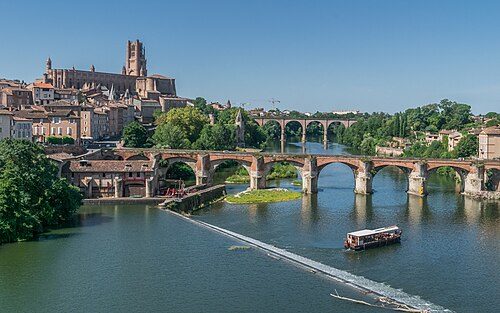
Albi
A red-brick episcopal city on the Tarn: a fortress-cathedral painted inside from floor to vault, and the world’s largest Toulouse-Lautrec collection.
 6h18
Coast · Occitanie
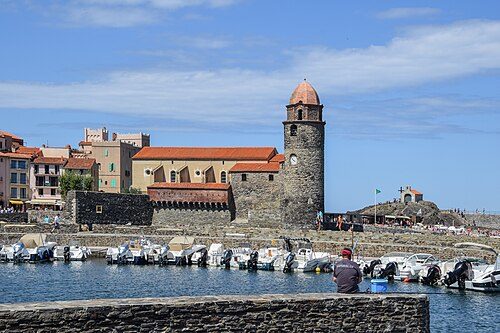
Collioure
A Catalan fishing port where the Pyrenees meet the Mediterranean, with a sea-washed church tower and the light that gave birth to Fauvism.
 6h37
Village · Occitanie
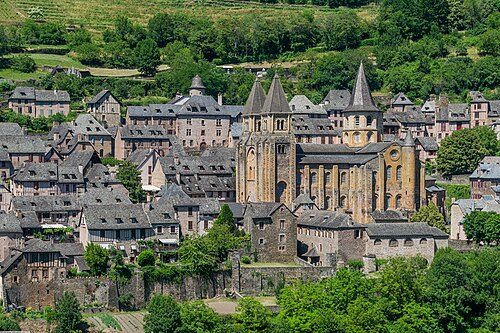
Conques
A slate-roofed village hidden in a wooded gorge, built around a Romanesque abbey church, a famous Last Judgement and a golden reliquary.
 3h36
Town · Provence-Alpes-Côte d’Azur
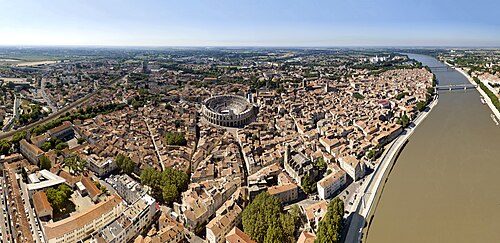
Arles
A Roman city on the Rhône where Van Gogh painted his brightest year, with an arena still in use and the Camargue at its gates.
Sources
- Wikipedia (en) – Cité de Carcassonne
- Encyclopædia Universalis – Carcassonne
- Tourisme Occitanie – Carcassonne
- OpenEdition Books – La cité de Carcassonne entre patrimoine d’exception et tourisme de masse
- Centre des monuments nationaux – Château et remparts de la cité de Carcassonne
- UNESCO World Heritage Centre – Historic Fortified City of Carcassonne
Original text. Train times computed from SNCF timetables (ODbL); climate Météo-France; products INAO; festivals Ministry of Culture. Methodology.