

Coast · Normandy
Étretat
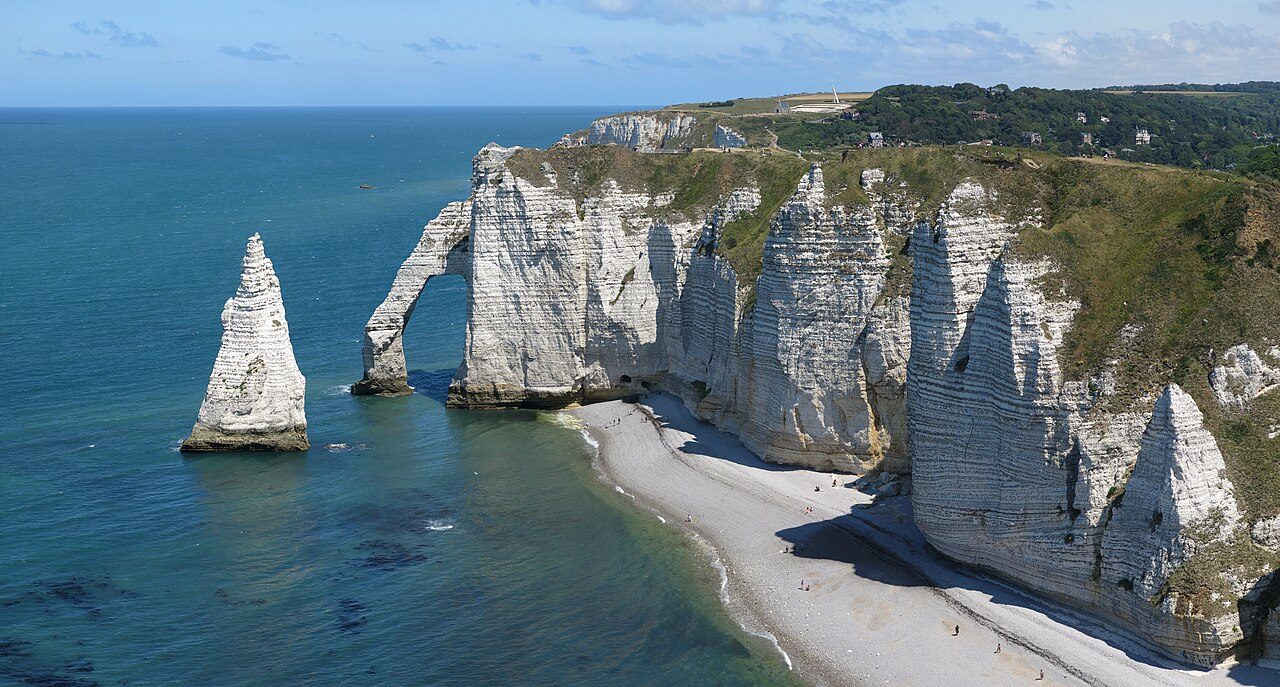
White chalk cliffs carved into arches and a needle, a shingle beach between them, and a village that painters and writers made famous.
Why go
Étretat is one of the few places in France where the landscape itself is the monument. The sea has cut the chalk into arches and a free-standing needle, and the clifftop paths on either side give views that Monet painted dozens of times. After a week of museums and metro, an afternoon walking the grassy cliff edges in the wind, with the Channel turning from grey to green below, is the cure. Come out of season, or stay for sunset, and it can feel wild again.
History
For most of its history Étretat was a fishing village on the Caux coast, its boats hauled up the shingle by hand and winch because there was no harbour. When a boat grew too old for the sea, fishermen roofed it with thatch and turned it into a shed: a few of these ‘caloges’ still line the beach.
The village was discovered by outsiders in the nineteenth century. The writer Alphonse Karr praised it in a novel published in 1836, and from the 1840s Parisian visitors began to arrive for sea bathing. Villas went up on the slopes behind the beach; the composer Jacques Offenbach named his after his operetta ‘Orpheus in the Underworld', and Guy de Maupassant, who spent part of his childhood here, later had a house built in the village.
Painters came for the light and the rock. Courbet painted the Aval cliff in 1869-1870, and Claude Monet returned several times in the 1880s, painting the arches and the Needle in every weather and at every hour. In the early twentieth century the novelist Maurice Leblanc, who lived in Étretat, hid the treasure of the kings of France inside the Needle in his Arsène Lupin novel ‘L’Aiguille creuse’ ('The Hollow Needle'), and the rock has carried the legend ever since.
In May 1927 the aviators Charles Nungesser and François Coli set off from Paris to fly non-stop to New York aboard ‘L’Oiseau blanc'. Their aircraft was last seen over the French coast near Étretat and never found. A monument on the Amont cliff, beside the sailors’ chapel of Notre-Dame-de-la-Garde, remembers them; both were destroyed in the Second World War and later rebuilt.
What to see
Falaise d’Aval, the Porte d’Aval and the Needle
The western cliff, the one on every postcard: a great arch of chalk stepping into the sea, with the pointed Needle standing alone just offshore. A path climbs from the end of the beach to the grassy top. Keep well back from the edge: the chalk crumbles and the cliffs retreat a little every year.
The Manneporte
Further west along the clifftop, the largest of Étretat’s three arches, a vast vault of chalk opening onto the sea. Monet painted it several times. Seen from above, with the Porte d’Aval and the Needle lined up behind, it gives the finest view on this coast.
Falaise d’Amont and Notre-Dame-de-la-Garde
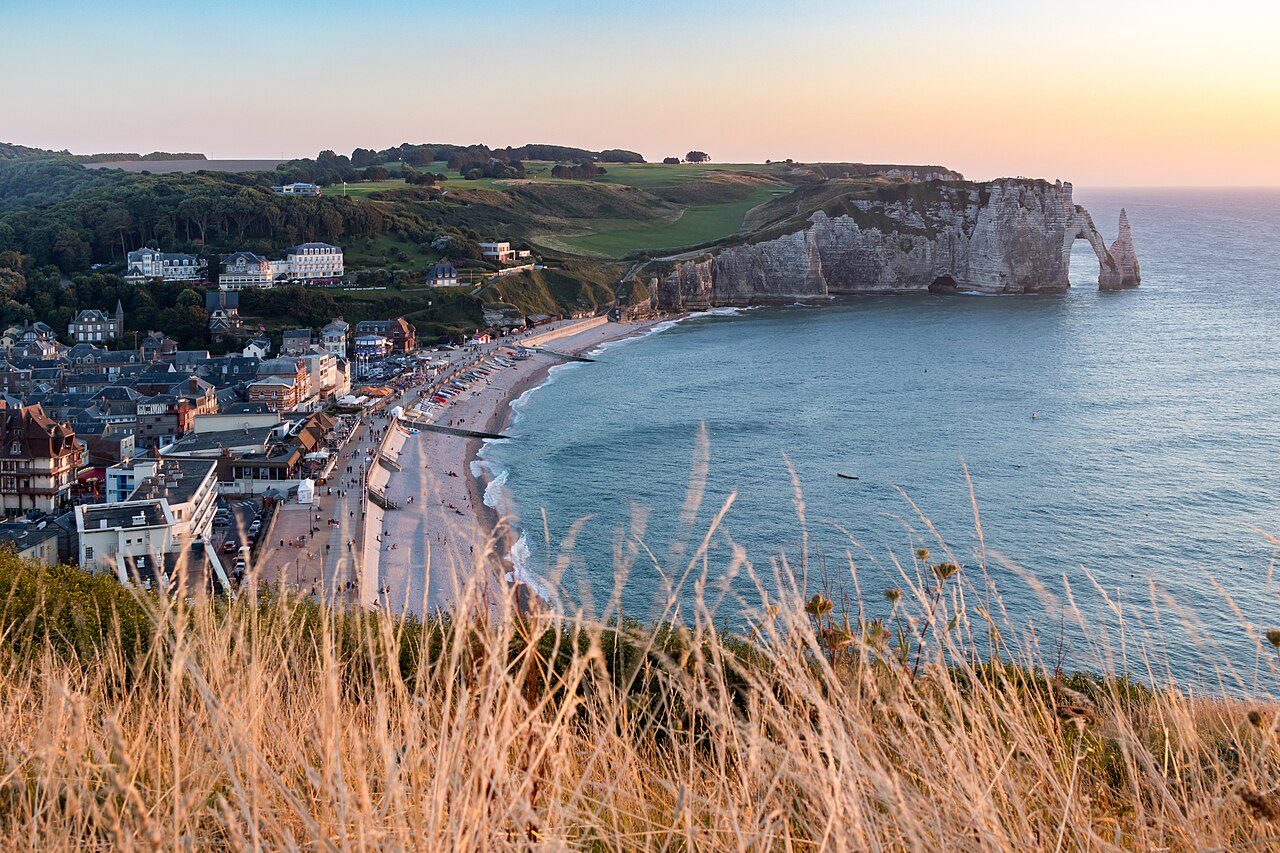
The eastern cliff, reached by a stairway and path from the end of the promenade. On top stand the little sailors’ chapel and the tall white monument to Nungesser and Coli. Looking back west, you see the whole bay, the town and the Porte d’Aval in one frame.
The beach at low tide
At low tide the shingle gives way to chalk platforms, rock pools and the foot of the cliffs, and you can walk under the arches. The tide comes back fast and has cut people off: check the tide tables at the tourist office before setting out, and never go through the cliff tunnels on a rising tide.
Le Clos Lupin
Maurice Leblanc’s half-timbered house, where he wrote many of the Arsène Lupin stories, is now a small museum built around the gentleman burglar. A light-hearted stop that explains why so many French visitors look at the Needle and think of hidden treasure.
Climate
Météo-France normals 1991-2020, station Cap-De-La-Heve (100 m, 24.1 km away).
| Jan | Feb | Mar | Apr | May | Jun | Jul | Aug | Sep | Oct | Nov | Dec | |
|---|---|---|---|---|---|---|---|---|---|---|---|---|
| High °C | 7.6 | 8.0 | 10.5 | 13.3 | 16.2 | 19.0 | 20.9 | 21.2 | 19.1 | 15.5 | 11.3 | 8.4 |
| Low °C | 3.9 | 3.9 | 5.6 | 7.5 | 10.3 | 13.1 | 15.1 | 15.6 | 13.7 | 10.8 | 7.4 | 4.7 |
| Rain (mm) | 68 | 54 | 52 | 52 | 56 | 58 | 49 | 66 | 65 | 86 | 88 | 96 |
| Rain days | 12 | 11 | 10 | 10 | 9 | 9 | 8 | 9 | 9 | 12 | 14 | 15 |
Timeline
- 1836 Alphonse Karr’s novel draws attention to the village
- 1840s Sea bathing begins to turn the fishing village into a resort
- 1869 Courbet paints the Aval cliff
- 1880s Monet’s repeated stays and series of cliff paintings
- 1909 Maurice Leblanc’s ‘L’Aiguille creuse’ published in book form
- 1927 Nungesser and Coli’s ‘L’Oiseau blanc’ is last seen near Étretat
Uncertain or disputed
- The height of the Needle is given anywhere from about 50 to 70 metres depending on the source; we do not quote a figure.
- The first construction date of the chapel of Notre-Dame-de-la-Garde is given as 1854 or 1856; it was rebuilt after the Second World War, around 1950.
Crowds: Very busy in season. Summer days, weekends and holidays bring heavy traffic and full car parks from mid-morning; arrive early, come in the shoulder seasons, or walk the cliffs at the end of the day. (editorial judgement)
Protected food & drink from here
AOP and IGP products whose official area includes this commune (INAO). Regional food: AOP & IGP →
Meat & charcuterie
- Porc de Normandie IGP · pork
- Volailles de Normandie IGP · poultry
Seafood & salt
- Huître de Normandie IGP · shellfish
Cider & spirits
- Cidre de Normandie ou Cidre normand IGP · cider
- Eau-de-vie de cidre de Normandie IG · cider or perry brandy
- Eaux-de-vie de poiré de Normandie IG · cider or perry brandy
Festivals within 15 km
From the Ministry of Culture’s national list; it gives a season, not dates.
| Festival | Discipline | Season |
|---|---|---|
| Eurydice festival Fécamp | Film | 6 Sep – 31 Dec |
| Hello Birds Etretat | Music | 21 Jun – 5 Sep |
| La Frairie Saint-Martin-du-Bec | Music | 21 Jun – 5 Sep |
Also in this part of France
 2h12
Coast · Normandy
Honfleur
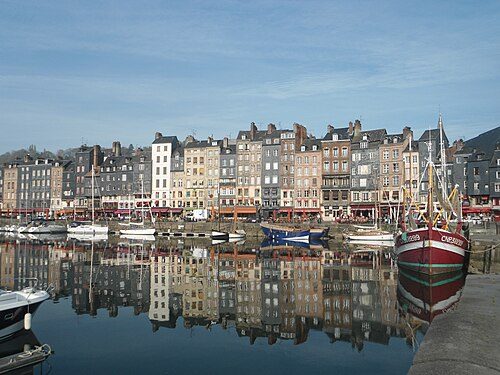
A slate-hung harbour town at the mouth of the Seine, where explorers sailed for Canada and painters learned to paint the sky.
 2h12
Town · Normandy
Bayeux
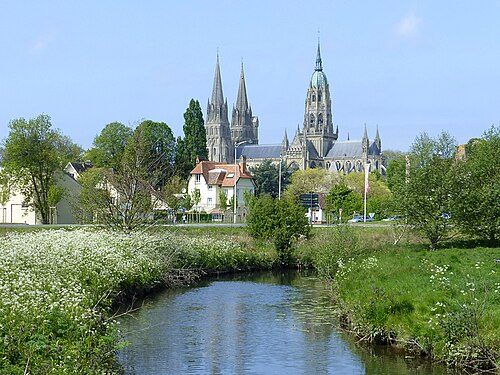
Home of the Tapestry, freed the day after D-Day: a Norman cathedral, water mills on the river Aure and the landing beaches close by.
 2h39
Village · Hauts-de-France
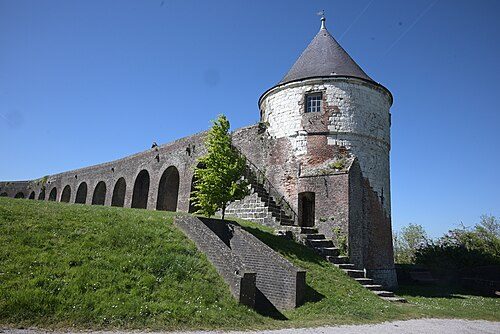
Montreuil-sur-Mer
A walled hilltop town that lost its sea, where Victor Hugo set the opening of Les Misérables and Haig ran the British army in the First World War.
 1h06
City · Hauts-de-France
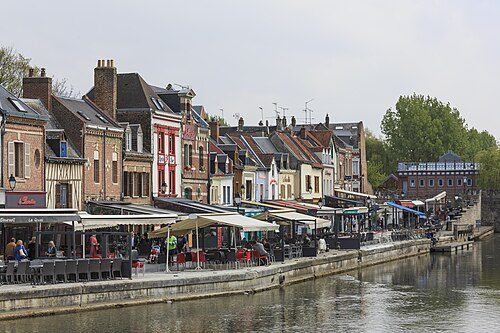
Amiens
France’s largest Gothic cathedral, floating market gardens reached by flat-bottomed boat, and the town where Jules Verne spent his last thirty years.
Sources
- Wikipédia (fr) – Étretat
- Seine-Maritime Attractivité – Falaise d’Amont
- France Today – Étretat and the Normandy coastline: endless inspiration for artists
- Wikipedia (en) – L’Oiseau Blanc
- Wikipedia (en) – The Hollow Needle
Original text. Train times computed from SNCF timetables (ODbL); climate Météo-France; products INAO; festivals Ministry of Culture. Methodology.