
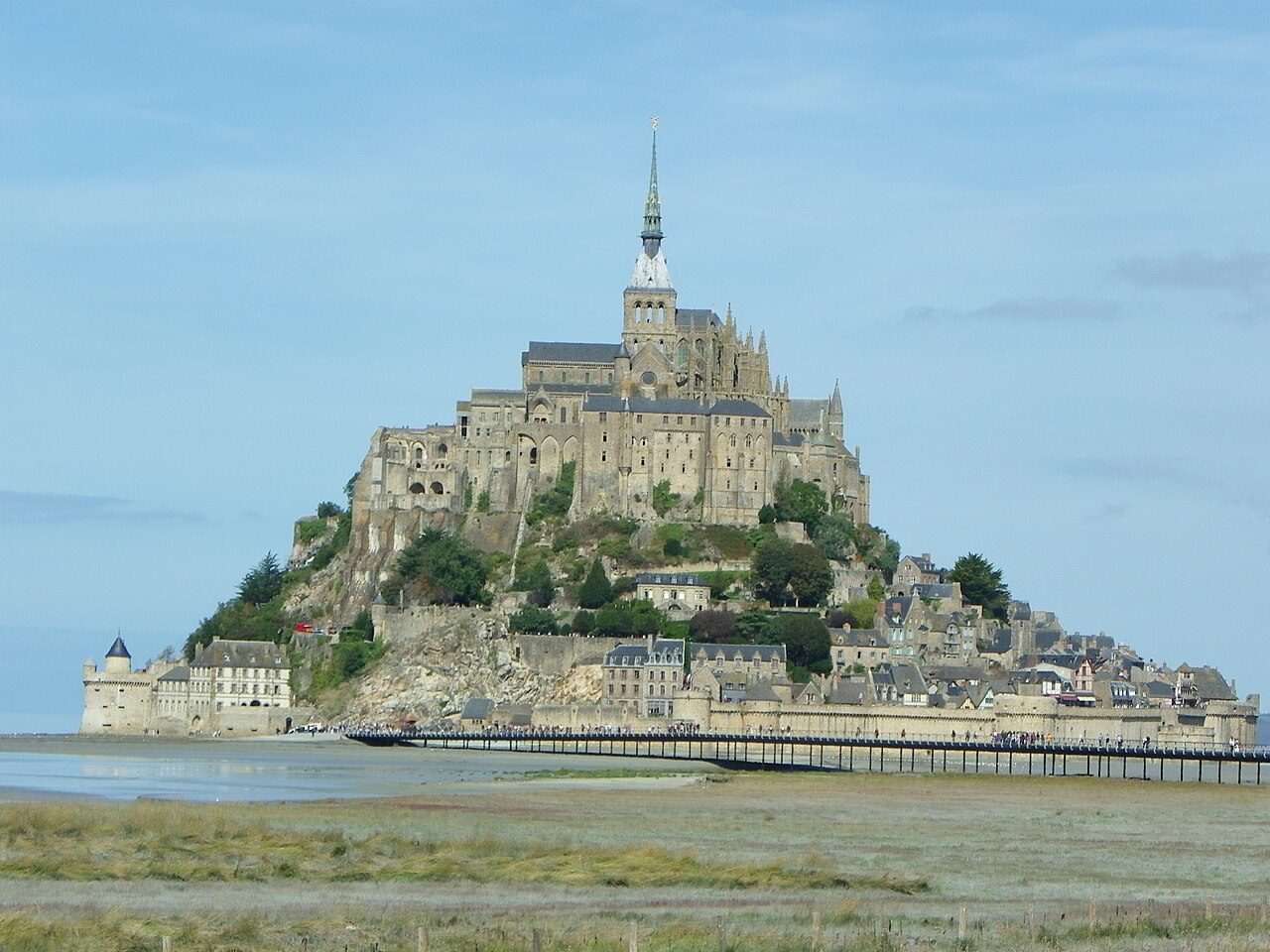

Normandy
Apple orchards and half-timbered farms, chalk cliffs and tidal bays, the D-Day beaches and an abbey rising from the sands.
Normandy takes its name from the Norsemen who settled at the mouth of the Seine in the tenth century, and its history has been tied to the sea and to England ever since: in 1066 its duke, William, crossed the Channel and became king. Split in two in the 1950s, the region was reunited on 1 January 2016. Rouen, with its cathedral painted again and again by Monet, and Caen, William’s city, share the role of capital.
Its countryside is the very picture of rural France: hedged fields, apple and pear orchards, half-timbered farmhouses and brown-and-white cows in the Pays d’Auge, the Perche and the Bocage. The coast is just as varied, from the white cliffs of the Pays de Caux to the resorts of the Côte Fleurie and the immense tidal bay where the Mont-Saint-Michel rises from the sands, one of the sights that make people fall in love with France.
Between them lie the landing beaches of 6 June 1944, added to the World Heritage List in 2026, with their cemeteries, museums and quiet dunes. Normandy is close to Paris, which is why Parisians fill its seaside towns at weekends; go midweek, or head inland to the orchards and the Suisse normande valleys, and you will find it calm. The weather is changeable, and the light that drew the Impressionists comes with it.
Facts
- Lower Normandy and Upper Normandy were merged into a single region on 1 January 2016.
- Mont-Saint-Michel and its Bay were among the first French sites inscribed by UNESCO, in 1979.
- The Beaches of the D-Day Landings, Normandy, 1944 were inscribed on the World Heritage List in 2026.
- Le Havre, the city rebuilt by Auguste Perret after 1945, was inscribed by UNESCO in 2005.
Places in Normandy
 1h49
Coast · Normandy
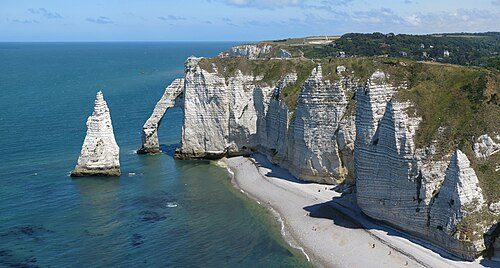
Étretat
White chalk cliffs carved into arches and a needle, a shingle beach between them, and a village that painters and writers made famous.
 2h12
Coast · Normandy
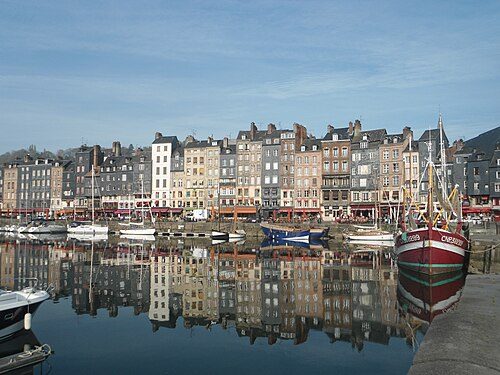
Honfleur
A slate-hung harbour town at the mouth of the Seine, where explorers sailed for Canada and painters learned to paint the sky.
 2h12
Town · Normandy
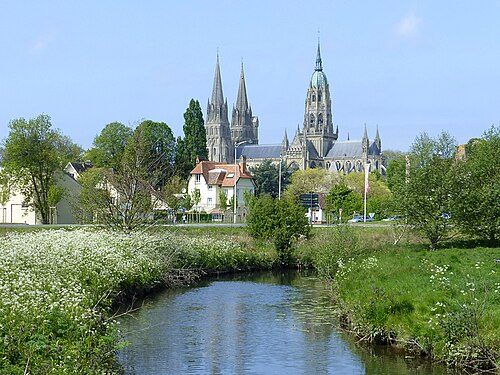
Bayeux
Home of the Tapestry, freed the day after D-Day: a Norman cathedral, water mills on the river Aure and the landing beaches close by.
Climate
Reference station: Rouen-Boos (156 m). Météo-France, 1991–2020 normals.
| Jan | Feb | Mar | Apr | May | Jun | Jul | Aug | Sep | Oct | Nov | Dec | |
|---|---|---|---|---|---|---|---|---|---|---|---|---|
| High °C | 6.9 | 7.9 | 11.4 | 14.8 | 17.9 | 21.1 | 23.4 | 23.4 | 20.1 | 15.4 | 10.4 | 7.3 |
| Low °C | 1.6 | 1.6 | 3.5 | 5.2 | 8.3 | 11.1 | 13.0 | 13.1 | 10.6 | 8.0 | 4.6 | 2.1 |
| Rain (mm) | 76 | 65 | 62 | 56 | 67 | 64 | 64 | 70 | 62 | 79 | 80 | 102 |
| Rain days | 14 | 12 | 11 | 10 | 11 | 9 | 9 | 10 | 9 | 13 | 13 | 14 |
Food and drink
Normandy cooks with cream, butter and apples. Its cheeses are household names, Camembert, Livarot, Pont-l’Évêque and Neufchâtel, and its butter and cream from Isigny carry a protected designation. Orchards give cider, perry, Pommeau and Calvados, the apple brandy sipped mid-meal as the ‘trou normand'. The coast lands scallops, mussels from Barfleur and oysters from the Cotentin, and lamb grazes the salt meadows of the Mont-Saint-Michel bay. Finish with a teurgoule, rice slow-baked with cinnamon.
AOP and IGP products whose official area lies mostly in this region (INAO). Regional food: AOP & IGP →
Cheese 4
- Camembert de Normandie AOP
- Livarot AOP
- Neufchâtel AOP
- Pont-l'Évêque AOP
Meat & charcuterie 3
- Porc de Normandie IGP
- Prés-salés du Mont-Saint-Michel AOP
- Volailles de Normandie IGP
Fruit, vegetables & nuts 1
- Poireaux de Créances IGP
Seafood & salt 2
- Bulot de la Baie de Granville IGP
- Huître de Normandie IGP
Butter, oil, honey & more 2
- Beurre d'Isigny AOP
- Crème d'Isigny AOP
Cider & spirits 9
- Calvados Pays d'Auge IG
- Cidre Cotentin ou Cotentin AOP
- Cidre de Normandie ou Cidre normand IGP
- Cidre du Perche ou Perche AOP
- Domfront AOP
- Eau-de-vie de cidre de Normandie IG
- Eaux-de-vie de poiré de Normandie IG
- Pays d'Auge AOP
- Pommeau de Normandie IG
Festivals
The Ministry of Culture lists 267 festivals in the region: 95 1 Jan – 20 Jun · 104 21 Jun – 5 Sep · 68 6 Sep – 31 Dec.
Signature festivals
- Carnaval de Granville — Granville, usually in February. Five days of floats, masks and satire around Mardi Gras in a Normandy fishing port, a tradition rooted in the send-off for cod fishermen leaving for Newfoundland. Its first organised edition was in 1875. As it follows Mardi Gras, it usually falls in February but some years in early March.
- Festival du cinéma américain de Deauville — Deauville, usually in September. Since 1975 the Normandy seaside resort has spent ten days each September celebrating American cinema, from studio premieres to independent films in competition, with the stars’ names painted on beach cabins along the boardwalk.
Plus Beaux Villages de France in the region (7)
| Village | Nearest railway station | Time from Paris |
|---|---|---|
| Lyons-la-Forêt | Morgny 21.5 km away | 1h43 |
| Le Bec-Hellouin | Brionne 4.1 km away | 1h55 |
| Saint-Céneri-le-Gérei | Alençon 12.7 km away | 1h58 |
| Blangy-le-Château | Pont-l'Évêque 7.6 km away | 2h02 |
| Beuvron-en-Auge | Mézidon - Canon 13.4 km away | 2h07 |
| Veules-les-Roses | Saint-Aubin-sur-Scie 19.1 km away | 2h39 |
| Barfleur | Valognes 24.0 km away | 2h51 |
“Les Plus Beaux Villages de France” is a registered trademark of the association of the same name (INPI no. 1 659 572, according to its charter). This site is independent and not affiliated with the association; the list of members is shown as a fact.
Sources
Photo: Rolf Kranz, CC BY-SA 4.0, Wikimedia Commons
