
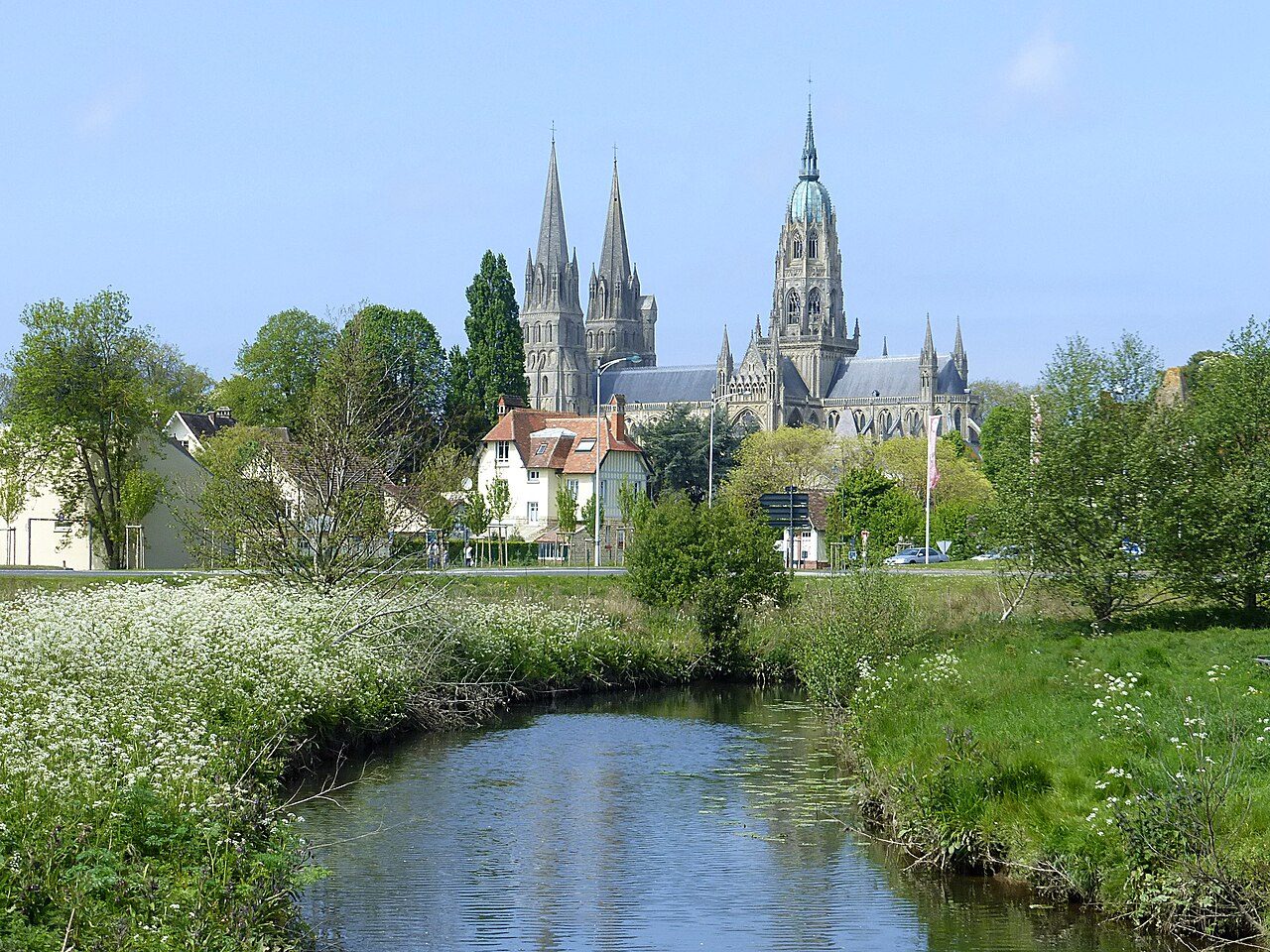

Town · Normandy · Altitude 45 m
Bayeux
Home of the Tapestry, freed the day after D-Day: a Norman cathedral, water mills on the river Aure and the landing beaches close by.
Why go
Bayeux holds two of the great hinges of European history, 1066 and 1944, in one compact, unbombed old town. The cathedral where the Tapestry was probably first hung still towers over half-timbered streets and mill races on the little river Aure, and the D-Day beaches are a short drive away. It is a town of stone and water rather than of sights to tick off, and it is at its best on a quiet evening after the coaches have gone.
History
Bayeux was a Gallo-Roman town and an early bishopric before the Vikings settled the Bessin in the tenth century; the dukes of Normandy, descendants of those settlers, made it one of their towns. William, the future Conqueror, put his half-brother Odo in charge of the diocese, and Odo built a new cathedral, consecrated on 14 July 1077 in William’s presence.
The great embroidered strip now called the Bayeux Tapestry, nearly seventy metres long, tells the story of the conquest of England in 1066, from Harold’s journey to Normandy to his death at Hastings. It is widely thought to have been commissioned by Odo and made in England within a few years of the battle, then displayed in the cathedral. It narrowly survived the Revolution, when it was seized by the state in 1792, and later spent the Second World War in safekeeping before returning to Bayeux.
The cathedral itself burned twice in the twelfth century and was largely rebuilt in Gothic style from 1180, though the western towers and the crypt keep their Romanesque core. Centuries of quiet prosperity as a bishop’s seat and market town left the stone mansions and timber-framed houses of the old centre.
On 7 June 1944, the day after the Normandy landings, British troops from Gold Beach entered Bayeux, which the German garrison had left without a fight; it was one of the first towns in France to be liberated, and it was spared. On 14 June General de Gaulle spoke there on what is now Place de Gaulle, and he returned on 16 June 1946 to set out his ideas for a constitution. The Commonwealth war cemetery on the edge of town holds more than four thousand graves.
What to see
The Bayeux Tapestry (on loan in London until July 2027)
The eleventh-century embroidery normally hangs in its own museum in Bayeux, but the museum closed for a full renovation in 2025 and the Tapestry is on show at the British Museum in London until 11 July 2027. It is due back in Bayeux for the museum’s reopening; check the museum’s site before planning a visit around it.
Notre-Dame cathedral
A Gothic cathedral wrapped around a Norman one. Inside, look at the nave arcades, where the lower Romanesque arches are covered in carved zigzags and interlace, then go down to the eleventh-century crypt with its painted angels. Outside, the spiky Gothic east end is best seen from the little streets behind.
The Aure and its mills
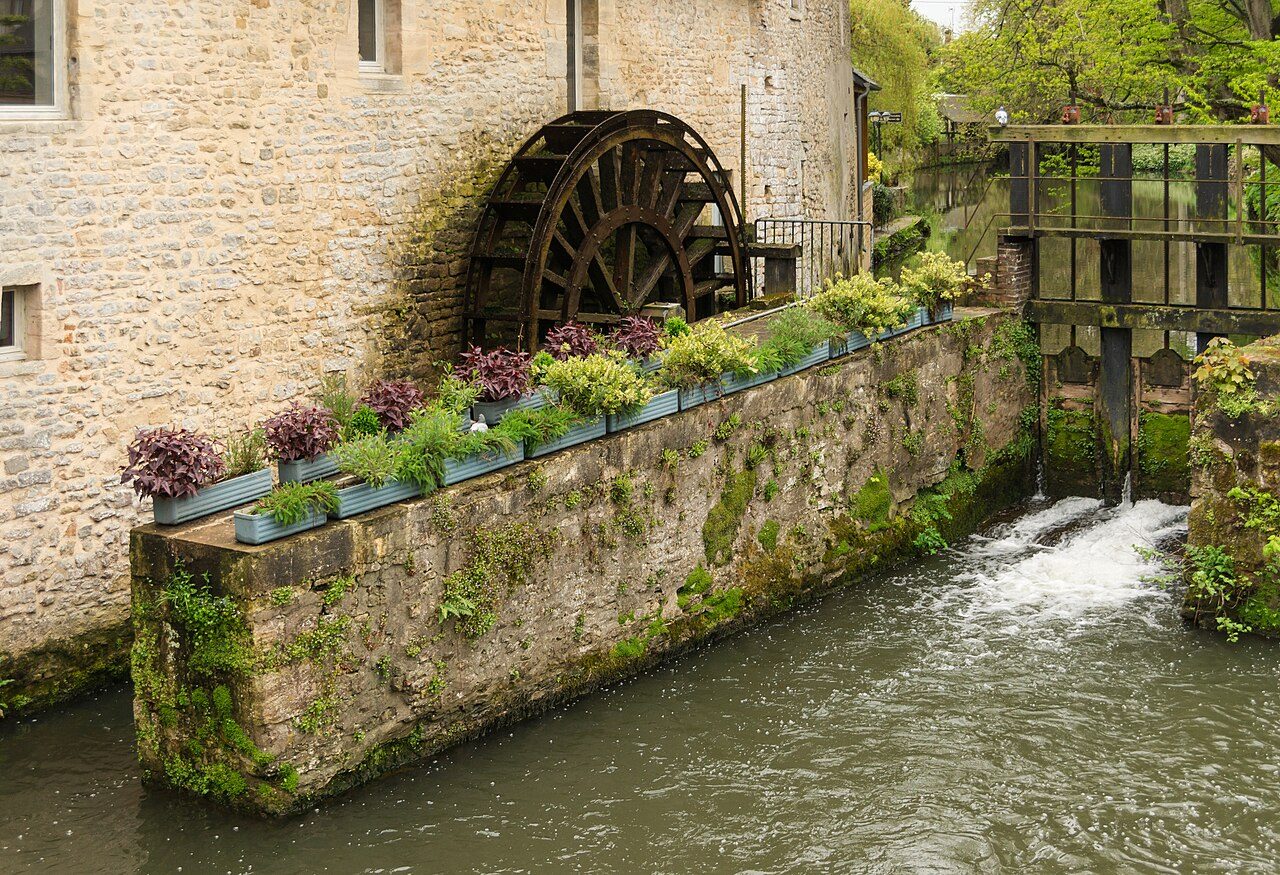
The little river runs through the old town between stone houses, turning old water wheels and passing tanneries and wash houses. A riverside path follows it from the fish market to the outskirts, with some of the best views of the cathedral’s towers above the trees.
Museum of the Battle of Normandy
A museum that explains the whole summer of 1944, from the landings to the closing of the Falaise pocket, rather than a single beach. It is the right place to start before driving out to the coast, and it stands opposite the Commonwealth war cemetery.
Bayeux War Cemetery and memorial
The largest Commonwealth cemetery of the Second World War in France, with rows of white headstones from many nations, Germans among them. The memorial across the road names soldiers with no known grave; its Latin inscription recalls that those once conquered by William came back to free his homeland.
Climate
Météo-France normals 1991-2020, station Caen-Carpiquet (67 m, 20.8 km away). Sunshine: Caen-Carpiquet station (20.8 km).
| Jan | Feb | Mar | Apr | May | Jun | Jul | Aug | Sep | Oct | Nov | Dec | |
|---|---|---|---|---|---|---|---|---|---|---|---|---|
| High °C | 8.3 | 9.1 | 11.7 | 14.4 | 17.4 | 20.5 | 22.9 | 23.2 | 20.4 | 16.2 | 11.8 | 8.8 |
| Low °C | 2.9 | 2.8 | 4.2 | 5.5 | 8.5 | 11.2 | 13.1 | 13.3 | 11.1 | 8.8 | 5.6 | 3.3 |
| Rain (mm) | 63 | 53 | 50 | 53 | 59 | 58 | 51 | 60 | 54 | 79 | 79 | 81 |
| Rain days | 12 | 11 | 10 | 10 | 10 | 9 | 8 | 8 | 9 | 12 | 13 | 14 |
| Sunshine (h) | 70 | 90 | 130 | 179 | 203 | 213 | 218 | 205 | 171 | 117 | 82 | 67 |
Timeline
- 1066 Norman conquest of England, the story told by the Tapestry
- 1077 Bishop Odo’s cathedral consecrated on 14 July in William’s presence
- 1180 Gothic rebuilding of the cathedral begins after fires
- 1944 7 June: British troops enter Bayeux; 14 June: de Gaulle’s first speech on French soil
- 1946 16 June: de Gaulle’s Bayeux speech on the constitution
- 2025 The Tapestry museum closes for renovation
- 2026 The Tapestry goes on show at the British Museum (until 11 July 2027)
Uncertain or disputed
- Who commissioned the Tapestry, where and exactly when it was made are not documented; Bishop Odo and English workshops are the prevailing scholarly view, not established fact.
- We give no reopening date for the Tapestry museum in Bayeux: none was confirmed at the time of writing.
- Sources call Bayeux ‘the first town in France’ to be liberated; liberation came to several places in the first days, so we say ‘one of the first'.
Crowds: Busy at peaks. Early June, around the D-Day anniversary, and the summer months are the busiest; outside those, and after the day tours leave in the late afternoon, the old town is calm. (editorial judgement)
Protected food & drink from here
AOP and IGP products whose official area includes this commune (INAO). Regional food: AOP & IGP →
Cheese
- Camembert de Normandie AOP · soft bloomy-rind cheese
- Pont-l'Évêque AOP · soft washed-rind cheese
Meat & charcuterie
- Porc de Normandie IGP · pork
- Volailles de Normandie IGP · poultry
Butter, oil, honey & more
- Beurre d'Isigny AOP · butter
- Crème d'Isigny AOP · cream
Cider & spirits
- Cidre de Normandie ou Cidre normand IGP · cider
- Eau-de-vie de cidre de Normandie IG · cider or perry brandy
- Eaux-de-vie de poiré de Normandie IG · cider or perry brandy
- Pommeau de Normandie IG
Festivals within 15 km
From the Ministry of Culture’s national list; it gives a season, not dates.
| Festival | Discipline | Season |
|---|---|---|
| Festival International du Cirque de Bayeux Bayeux | Theatre, dance & street arts | 1 Jan – 20 Jun |
| Festival Musique sous les embruns Port-en-Bessin-Huppain | Music | 6 Sep – 31 Dec |
| Radio Meuh Circus Festival Esquay-sur-Seulles | Music | 1 Jan – 20 Jun |
| Route panoramique Arromanches-les-Bains | Books & comics | 6 Sep – 31 Dec |
| Soirées Littéraires du Bessin Asnelles | Theatre, dance & street arts | 21 Jun – 5 Sep |
| Urban Spaces - Rencontres des cultures urbaines Bayeux | Mixed | 21 Jun – 5 Sep |
Also in this part of France
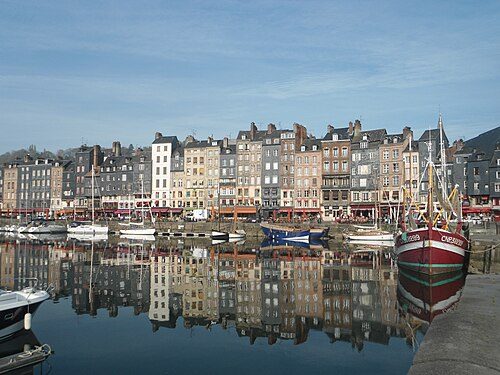 2h12
Coast · Normandy
Honfleur
A slate-hung harbour town at the mouth of the Seine, where explorers sailed for Canada and painters learned to paint the sky.
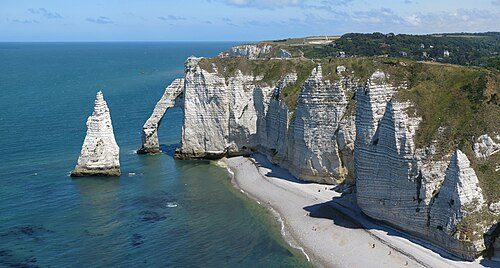 1h49
Coast · Normandy
Étretat
White chalk cliffs carved into arches and a needle, a shingle beach between them, and a village that painters and writers made famous.
 2h29
Coast · Brittany
Saint-Malo
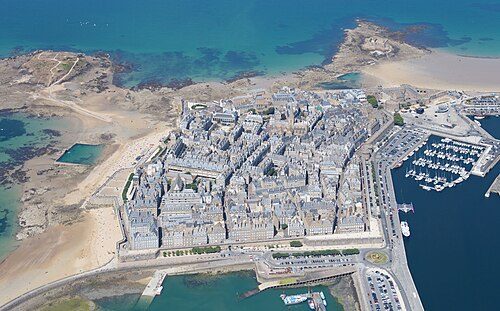
A granite corsair city ringed by ramparts, with island forts you can walk to at low tide and some of the biggest tides in Europe.
 3h02
Town · Brittany
Dinan
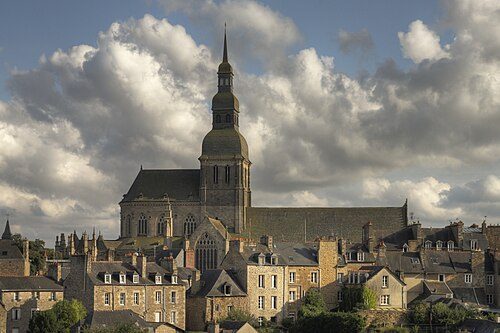
Half-timbered houses, 2.6 km of ramparts and a cobbled street plunging seventy-five metres down to a little port on the Rance.
Sources
- Wikipedia (en) – Bayeux Cathedral
- British Museum – press release: Bayeux Tapestry to be displayed at the British Museum
- GOV.UK – Bayeux Tapestry to go on display at the British Museum in 2026
- Ville de Bayeux – D-Day booklet
- Chemins de mémoire – Sur les pas du général de Gaulle dans le Bessin
- Wikipedia (en) – First Bayeux speech
Original text. Train times computed from SNCF timetables (ODbL); climate Météo-France; products INAO; festivals Ministry of Culture. Methodology.