

Coast · Brittany
Saint-Malo
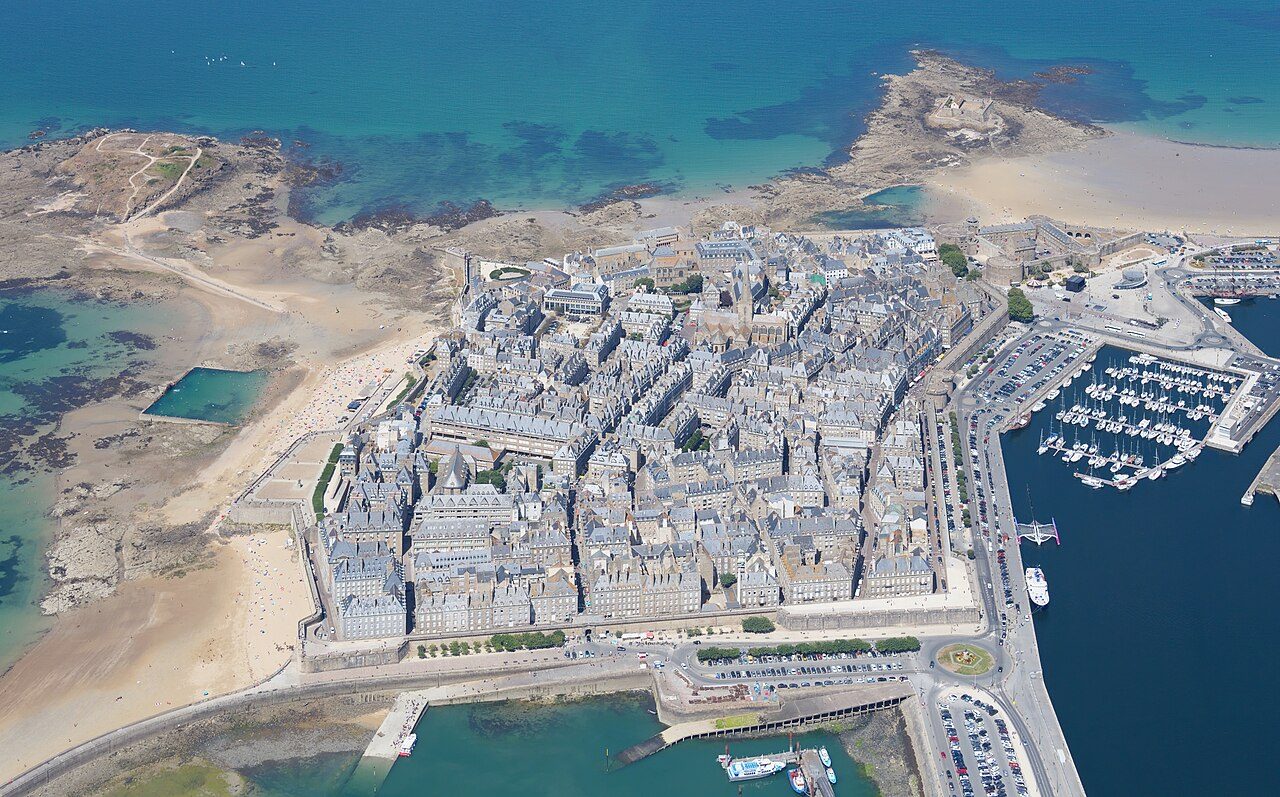
A granite corsair city ringed by ramparts, with island forts you can walk to at low tide and some of the biggest tides in Europe.
Why go
Saint-Malo is a city that answers to the sea, not to Paris: its proud old motto declared it neither French nor Breton, but Malouin. Walk the ramparts right round the old town and watch the tide, which can rise and fall by well over ten metres, swallow the beaches and then hand back causeways to island forts and a writer’s grave. The granite town you see was largely rebuilt after 1944, with real care, and that story is part of its power.
History
The first town here was Alet, on the headland now inside Saint-Servan. Tradition says that in the sixth century a monk from what is now Wales, Malo, joined a hermit named Aaron on a rocky island nearby; the island took the saint’s name and, as raids made Alet unsafe, slowly became the real town, walled and almost entirely surrounded by water. In 1145 the bishops’ seat moved there from Alet.
Saint-Malo always guarded its independence. During the Wars of Religion its notables threw out the royal governor in March 1590 and ran the town as a self-governing republic until 1594; from that episode comes the motto ‘Ni Français, ni Breton, Malouin suis'. Its sailors went everywhere: Jacques Cartier, born here in 1491, sailed from Saint-Malo in the 1530s to explore the Saint Lawrence, and settlers from the port gave the Falkland Islands their French name, the Malouines.
The seventeenth and eighteenth centuries were the age of the corsairs, licensed privateers such as Duguay-Trouin and later Surcouf who preyed on enemy shipping, and of rich shipowners who built country houses called malouinières. That wealth had a darker source too: Saint-Malo was France’s fifth-largest slave-trading port, and an estimated 80,000 enslaved Africans were carried on ships fitted out here. Vauban’s engineers strengthened the defences, building Fort National in 1689. François-René de Chateaubriand was born in the town in 1768.
In August 1944 German forces held out in the walled city and American bombardment almost totally destroyed it; the ramparts survived. The town was rebuilt inside them over the following decades, not stone for stone but in the old style, with some buildings reassembled from numbered stones. Today the port runs ferries to Britain and the Channel Islands, and every four years the Route du Rhum yacht race sets off from here for Guadeloupe.
What to see
The ramparts walk
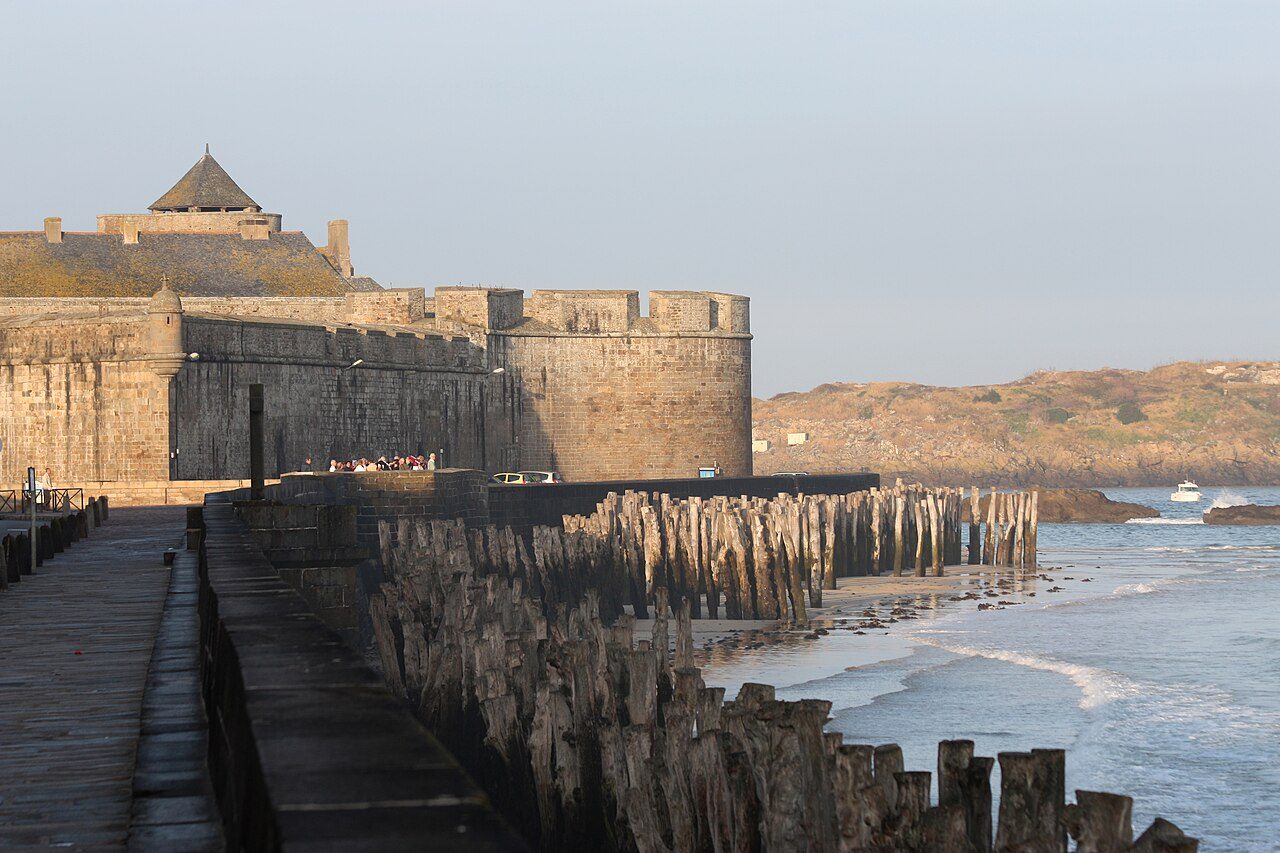
The walls run almost all the way round the old town, and you can walk on top of them for free. On one side are the beaches, the island forts and the open sea; on the other the tall granite houses of the shipowners. Do it twice if you can, at high and at low tide.
Fort National
Built in 1689 to plans by Vauban, the fort stands on a tidal island a few hundred metres off the walls. At low tide you can walk out across the sand; it can be visited on certain days, mainly in summer, when its flag is flying. Watch the tide times closely.
Grand Bé and Chateaubriand’s tomb
From the Bon-Secours beach a causeway uncovered at low tide leads to the Grand Bé, where Chateaubriand chose to be buried facing the sea, under a plain stone cross. The view back to the walled city is the best in town. Do not get caught by the incoming tide.
Bon-Secours tidal pool
Built in 1936 to plans by the town architect below the ramparts, this seawater pool is filled by every high tide and emerges again as the water drops. It is one of the largest of its kind in Europe, and swimming in it with the walls above you is a very Malouin pleasure, cold water included.
Saint-Vincent cathedral
The former cathedral, Romanesque and Gothic, was badly damaged in 1944 and restored until 1972; all its stained glass is post-war, and it fills the nave with deep colour. A floor mosaic marks where Jacques Cartier knelt before his 1535 voyage, and his tomb is in a side chapel.
Climate
Météo-France normals 1991-2020, station Dinard (65 m, 8.4 km away). Sunshine: Dinard station (8.4 km).
| Jan | Feb | Mar | Apr | May | Jun | Jul | Aug | Sep | Oct | Nov | Dec | |
|---|---|---|---|---|---|---|---|---|---|---|---|---|
| High °C | 9.1 | 9.8 | 12.2 | 14.5 | 17.3 | 20.2 | 22.1 | 22.3 | 20.3 | 16.5 | 12.4 | 9.7 |
| Low °C | 3.8 | 3.6 | 4.9 | 6.2 | 9.1 | 11.8 | 13.6 | 13.7 | 11.8 | 9.7 | 6.5 | 4.2 |
| Rain (mm) | 64 | 56 | 48 | 54 | 56 | 54 | 46 | 58 | 60 | 81 | 89 | 86 |
| Rain days | 12 | 11 | 10 | 10 | 9 | 8 | 8 | 9 | 9 | 13 | 14 | 14 |
| Sunshine (h) | 69 | 91 | 133 | 179 | 203 | 208 | 221 | 201 | 170 | 114 | 80 | 66 |
Timeline
- 6th c.? Tradition: Saint Malo joins the hermit Aaron on the island
- 1145 The bishops’ seat moves from Alet to the island town
- 1491 Birth of Jacques Cartier
- 1590 Saint-Malo declares itself an independent republic (until 1594)
- 1689 Fort National built to Vauban’s plans
- 1768 Birth of Chateaubriand
- 1944 The walled city is almost totally destroyed during its liberation
- 1972 Restoration of the cathedral completed
Uncertain or disputed
- The story of Saint Malo and the hermit Aaron is a tradition, and its date cannot be confirmed.
- The slave-trade figures are estimates: some 250 expeditions and around 80,000 people, according to one source.
- Sources give different dates for Saint Malo’s arrival: around 538 in one, around 560 in another.
Crowds: Very busy in season. July, August and sunny weekends fill the old town; come in spring or autumn, ideally around a big spring tide, and walk the ramparts early in the morning. (editorial judgement)
Protected food & drink from here
AOP and IGP products whose official area includes this commune (INAO). Regional food: AOP & IGP →
Meat & charcuterie
- Pâté de Campagne Breton IGP · charcuterie
- Volailles de Bretagne IGP · poultry
- Volailles de Janzé IGP · poultry
Butter, oil, honey & more
- Farine de blé noir de Bretagne - Gwinizh du Breizh IGP · flour
Cider & spirits
- Cidre de Bretagne ou Cidre breton IGP · cider
- Whisky breton ou Whisky de Bretagne IG
Festivals within 15 km
From the Ministry of Culture’s national list; it gives a season, not dates.
| Festival | Discipline | Season |
|---|---|---|
| Classique au large Saint-Malo | Music | 1 Jan – 20 Jun |
| Dinard Comedy Festival Dinard | Theatre, dance & street arts | 1 Jan – 20 Jun |
| Dinard OPéra d'Eté Dinard | Music | 21 Jun – 5 Sep |
| Festival de Musique Sacrée Saint-Malo | Music | 21 Jun – 5 Sep |
| Festival du Film Britannique de Dinard Dinard | Film | 6 Sep – 31 Dec |
| Festival du Grouin Cancale | Theatre, dance & street arts | 1 Jan – 20 Jun |
| Festival International de Musique de Dinard Dinard | Music | 21 Jun – 5 Sep |
| Festival Musiques Rive Gauche Dinard | Music | 21 Jun – 5 Sep |
| Fetlyf Lycéens sur les planches Saint-Malo | Music | 1 Jan – 20 Jun |
| Folklores du Monde Saint-Malo | Theatre, dance & street arts | 21 Jun – 5 Sep |
| Hello Birds Saint-Malo | Music | 6 Sep – 31 Dec |
| Jeux de Vagues Dinard | Music | 1 Jan – 20 Jun |
| L'Art est dans les Bois Pleslin-Trigavou | Visual & digital arts | 21 Jun – 5 Sep |
| La houle des mots Saint-Jacut-de-la-Mer | Books & comics | 21 Jun – 5 Sep |
| La Route des Orgues Saint-Malo | Music | 1 Jan – 20 Jun |
| La Route du Rire Saint-Malo | Music | 6 Sep – 31 Dec |
+ 10 — Festivals →
Also in this part of France
 3h02
Town · Brittany
Dinan
Half-timbered houses, 2.6 km of ramparts and a cobbled street plunging seventy-five metres down to a little port on the Rance.
 2h12
Town · Normandy
Bayeux
Home of the Tapestry, freed the day after D-Day: a Norman cathedral, water mills on the river Aure and the landing beaches close by.
 3h02
Town · Pays de la Loire
Guérande
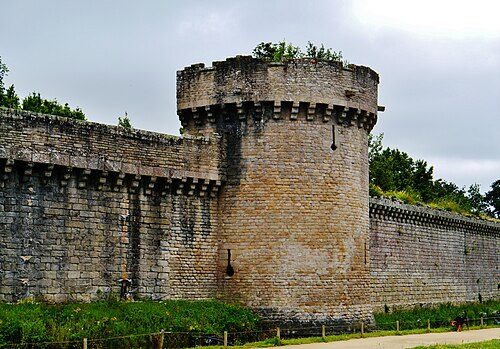
A walled Breton town of grey granite overlooking a chequerboard of salt marshes, where paludiers still rake salt by hand.
 3h28
Town · Brittany
Quimper
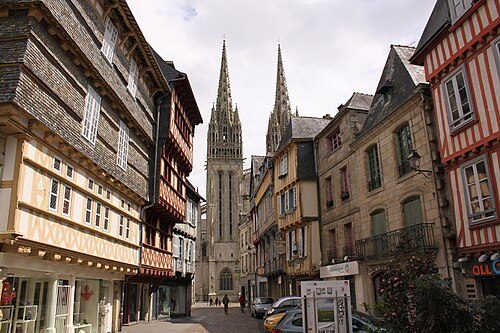
Capital of Cornouaille, where rivers meet under a crooked Gothic cathedral and hand-painted faience has been made since the seventeenth century.
Sources
- Wikipedia (fr) – Saint-Malo
- Wikipedia (en) – Saint-Malo
- Wikipedia (fr) – Fort National
- Wikipedia (en) – Fort National
- Wikipedia (en) – Grand Bé
- Wikipedia (fr) – Cathédrale Saint-Vincent de Saint-Malo
- Wikipedia (en) – Saint-Malo Cathedral
Original text. Train times computed from SNCF timetables (ODbL); climate Météo-France; products INAO; festivals Ministry of Culture. Methodology.