


Mountains · Nouvelle-Aquitaine · Altitude 185 m
Saint-Jean-Pied-de-Port
A walled Basque town of red sandstone on the river Nive, where pilgrims to Santiago set off over the Pyrenees.
Why go
This is where France runs out and the mountains begin. Saint-Jean-Pied-de-Port, Donibane Garazi in Basque, is a small walled town of red stone and white-and-red Basque houses at the foot of the pass into Spain. Every morning, walkers from all over the world pass through the Saint-Jacques gate and climb towards Roncesvalles. You do not have to be a pilgrim to feel the pull: the town, the river and the green hills of Basse-Navarre are a world away from Paris.
History
The name says it all: the town stands at the foot (pied) of the ‘port', the mountain pass over the Pyrenees to Roncesvalles. The route was used long before the town existed, by Roman roads and later by Charlemagne’s army, whose rearguard was ambushed in the Roncesvalles passes in 778, the event behind the ‘Song of Roland'.
The present town was laid out and fortified by the kings of Navarre in the twelfth and early thirteenth centuries, notably Sancho VII the Strong, to control the crossing. It became the capital of the part of the kingdom north of the mountains, Lower Navarre. When Castile conquered the southern part of Navarre in 1512, a Spanish army also took Saint-Jean; but in 1530 Charles V gave up the lands north of the Pyrenees, and Lower Navarre remained with the house of Albret, whose heir became Henry IV of France in 1589.
With the frontier now on the ridge above, the town became a strongpoint of the French kingdom. A citadel was built on the hill in 1625-1627 and strengthened between 1686 and 1700 following Vauban’s instructions, and it still watches over the valley.
Meanwhile the pilgrims never stopped. Since the Middle Ages, three of the great French routes to Santiago de Compostela have converged near here before the climb into Spain. Their revival since the late twentieth century has turned the town into the most famous starting point of the Camino Francés, and the Porte Saint-Jacques was inscribed by UNESCO in 1998 as part of the Routes of Santiago de Compostela in France.
UNESCO World Heritage: Routes of Santiago de Compostela in France (1998), for the Porte Saint-Jacques
Member of the association Les Plus Beaux Villages de France. The Plus Beaux Villages de France by train →
What to see
Porte Saint-Jacques and the rue de la Citadelle
Pilgrims arriving from France enter through this plain stone gate at the top of town, part of the UNESCO-listed Routes of Santiago. From it the cobbled rue de la Citadelle runs steeply down, lined with sandstone houses whose lintels carry carved dates and names, to the river.
Notre-Dame-du-Bout-du-Pont and the Nive
The Gothic church of red sandstone stands at the bottom of the main street, where its bell tower doubles as a town gate opening onto the old bridge. From the bridge, look upstream at the houses with wooden balconies hanging over the Nive: the town’s classic view.
The citadel
A seventeenth-century fortress on the hill above town, reworked to Vauban’s instructions. The walk up from the old town, by a steep path and steps, ends on the ramparts with a panorama over the roofs, the basin of Cize and the first mountains of the Pyrenees.
The ‘Prison des Évêques'
A medieval vaulted hall in the rue de la Citadelle, now used for exhibitions on Basque pelota, the Basque diaspora and local history. Its name, ‘Bishops’ prison', only appeared in the twentieth century: it probably recalls the rival bishops who lived here during the Great Schism, while the building served as a prison only briefly.
The first stage towards Roncesvalles
Even if you are not walking to Santiago, a few hours on the Route Napoléon above the town shows why pilgrims dread and love this stage: steep pasture, semi-wild ponies and vultures, and views back across the Basque hills. The full crossing is a long, demanding mountain day; check the weather and the pilgrims’ office advice first.

Climate
Météo-France normals 2003-2020, station Bustince - St Jean (189 m, 2.5 km away).
| Jan | Feb | Mar | Apr | May | Jun | Jul | Aug | Sep | Oct | Nov | Dec | |
|---|---|---|---|---|---|---|---|---|---|---|---|---|
| High °C | 11.8 | 12.6 | 15.3 | 18.1 | 20.7 | 24.4 | 26.2 | 26.4 | 24.5 | 21.1 | 15.4 | 13.0 |
| Low °C | 2.8 | 2.5 | 4.6 | 7.3 | 10.1 | 13.4 | 15.3 | 14.9 | 12.4 | 10.2 | 6.2 | 3.5 |
| Rain (mm) | 158 | 113 | 123 | 122 | 120 | 100 | 64 | 68 | 82 | 94 | 170 | 114 |
| Rain days | 14 | 11 | 13 | 13 | 13 | 10 | 9 | 9 | 8 | 10 | 13 | 13 |
Timeline
- 778 Charlemagne’s rearguard is ambushed at Roncesvalles, on the pass above
- early 13th c. Sancho VII of Navarre fortifies the town
- 1512 A Spanish army takes the town during the conquest of Navarre
- 1530 Charles V gives up Lower Navarre, which stays with the Albret dynasty
- 1625 Construction of the citadel begins
- 1686 Works on the citadel following Vauban’s instructions (to 1700)
- 1998 The Porte Saint-Jacques is inscribed by UNESCO with the Routes of Santiago in France
Uncertain or disputed
- Some accounts say the town was founded after Richard the Lionheart destroyed the older settlement of Saint-Jean-le-Vieux in the late 12th century; we could not confirm this in two sources and leave it out.
- Walking distances from Saint-Jean to Roncesvalles and to Santiago vary by route, so we give none.
Crowds: Busy at peaks. The pilgrim season from spring to autumn keeps the main street lively, and summer brings day visitors too; for a quieter town, come in late autumn or walk the lanes early in the morning after the pilgrims have left. (editorial judgement)
Protected food & drink from here
AOP and IGP products whose official area includes this commune (INAO). Regional food: AOP & IGP →
Cheese
- Ossau-Iraty AOP · pressed uncooked cheese
- Tomme des Pyrénées IGP · pressed uncooked cheese
Meat & charcuterie
- Canard à foie gras du Sud-Ouest IGP · meat product
- Jambon de Bayonne IGP · cured meat
- Jambon du Kintoa AOP · pork
- Kintoa AOP · pork
- Porc du Sud-Ouest IGP · pork
- Volailles de Gascogne IGP · poultry
- Volailles du Béarn IGP · poultry
Wine
- Comté Tolosan IGP
Also in this part of France
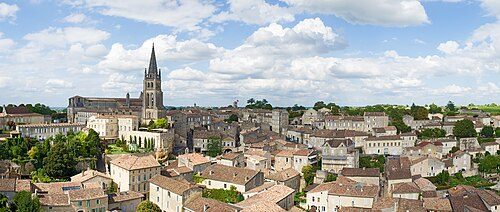 2h44
Village · Nouvelle-Aquitaine
Saint-Émilion
A honey-stone wine town tumbling into a hollow of the limestone, with a church carved out of the rock beneath its steep lanes.
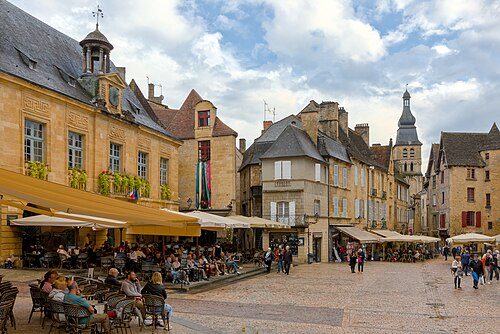 4h53
Town · Nouvelle-Aquitaine
Sarlat-la-Canéda
The golden-stone capital of the Périgord Noir: Gothic and Renaissance mansions, stone-slab roofs and one of France’s great food markets.
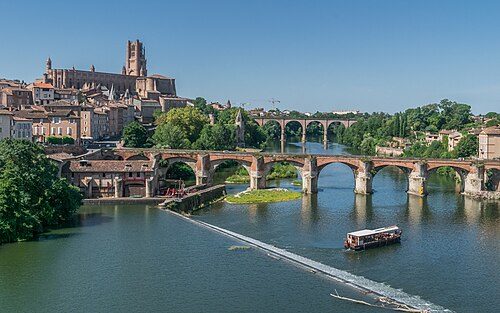 6h02
City · Occitanie
Albi
A red-brick episcopal city on the Tarn: a fortress-cathedral painted inside from floor to vault, and the world’s largest Toulouse-Lautrec collection.
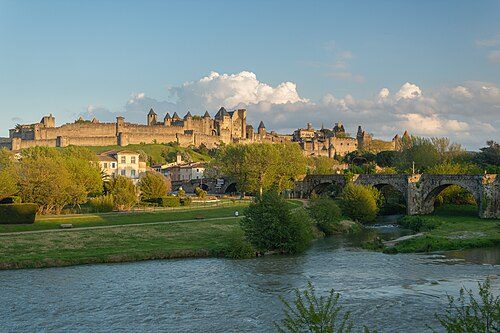 5h24
Town · Occitanie
Carcassonne
A medieval fortress city with two rings of walls and dozens of towers on a hill above the Aude, rescued from demolition in the 1850s.
Sources
- Wikipédia (fr) – Saint-Jean-Pied-de-Port
- Ayuntamiento de Pamplona – Camino de Santiago: Saint-Jean-Pied-de-Port / Donibane Garazi
- Cirkwi – Citadelle de Saint-Jean-Pied-de-Port
- Monumentum – Édifice dit Prison des Évêques
- Pays Basque tourisme – Prison dite des Évêques
- Routes touristiques – Saint-Jean-Pied-de-Port
- UNESCO World Heritage Centre – Routes of Santiago de Compostela in France
Original text. Train times computed from SNCF timetables (ODbL); climate Météo-France; products INAO; festivals Ministry of Culture. Methodology.