

Brittany
Granite headlands, standing stones, fishing ports and a Celtic language still on the signposts: France’s far west.
Brittany is the peninsula that France points at the Atlantic, and it has always looked outward. Its people speak French, but road signs are often bilingual in Breton, a Celtic language related to Welsh and Cornish, and its music, saints and festivals belong to a world that stretches to Ireland and Galicia. The duchy only joined the French crown in 1532. Rennes is the regional capital, Nantes was its historic ducal seat until it was attached to another region in the twentieth century, and Brest, Lorient and Saint-Malo still live by the sea.
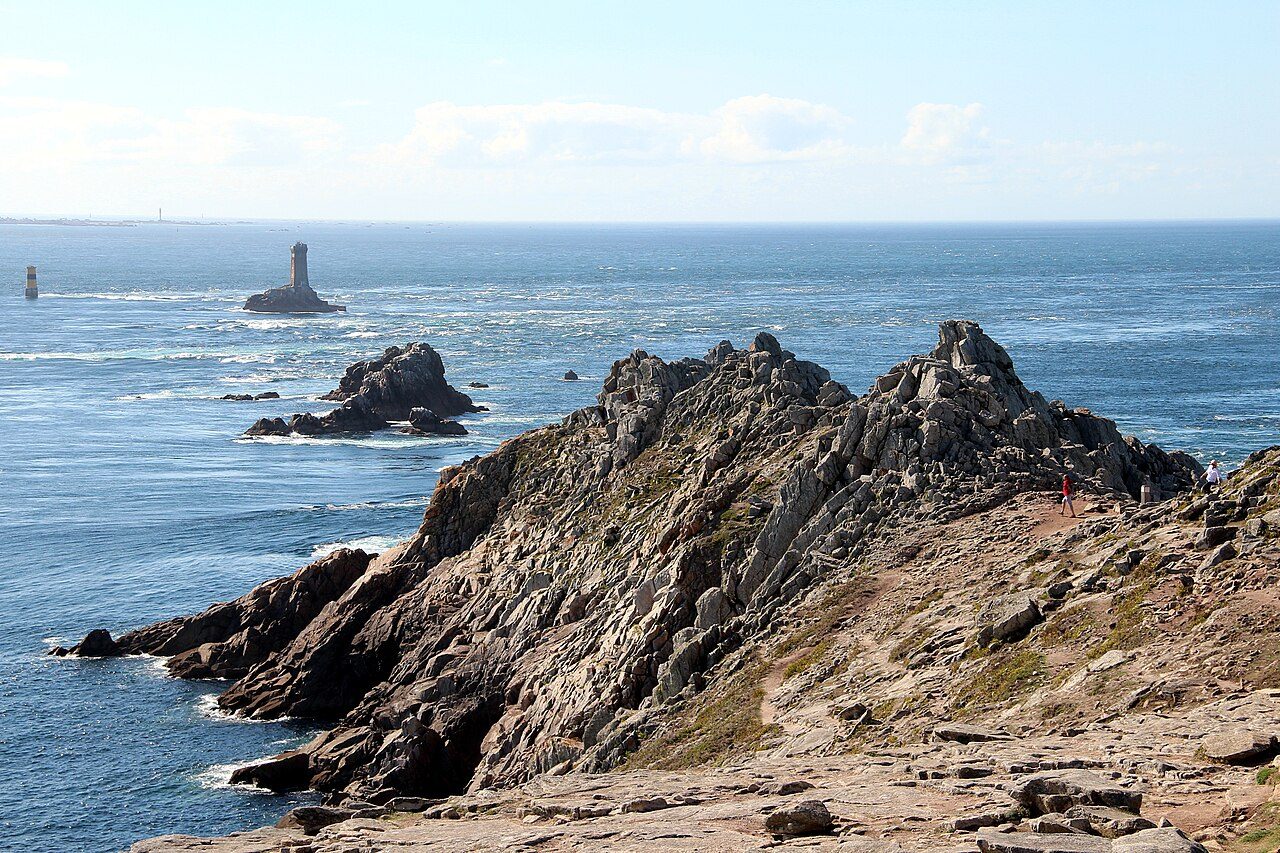
The coast is the main event, and it changes every few kilometres: pink granite boulders on the north shore, cliffs and lighthouses at the Pointe du Raz, sheltered rias where oysters grow, and the island-studded Gulf of Morbihan. Inland lies the Argoat, the ‘country of woods', with forests full of Arthurian legend, slate-roofed villages and the parish closes of Finistère, those walled churchyards crowded with carved calvaries.
Thousands of years before any of that, people raised the alignments of Carnac, rows of standing stones that UNESCO added to its list in 2025. For a visitor tired of Paris, Brittany offers weather that changes by the hour, ports where the catch is still landed in the afternoon, long coastal paths and a strong sense of being somewhere with its own identity. It is busy on the coast in August; in May, June or September it feels like yours.
Facts
- One of the few regions whose borders were left unchanged by the 2016 territorial reform; it has four departments: Côtes-d’Armor, Finistère, Ille-et-Vilaine and Morbihan.
- The Megaliths of Carnac and of the shores of Morbihan were inscribed on UNESCO’s World Heritage List in 2025.
- The Duchy of Brittany was united with the Kingdom of France by an edict of 1532.
Places in Brittany
 2h29
Coast · Brittany
Saint-Malo
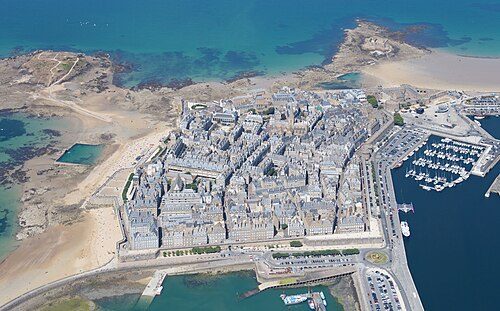
A granite corsair city ringed by ramparts, with island forts you can walk to at low tide and some of the biggest tides in Europe.
 3h02
Town · Brittany
Dinan
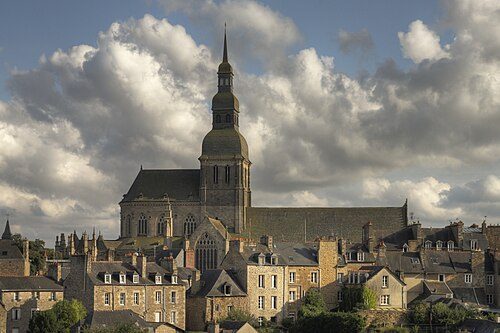
Half-timbered houses, 2.6 km of ramparts and a cobbled street plunging seventy-five metres down to a little port on the Rance.
 3h28
Town · Brittany
Quimper
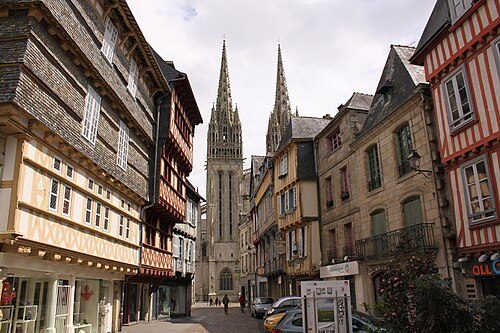
Capital of Cornouaille, where rivers meet under a crooked Gothic cathedral and hand-painted faience has been made since the seventeenth century.
Climate
Reference station: Rennes-St Jacques (36 m). Météo-France, 1991–2020 normals.
| Jan | Feb | Mar | Apr | May | Jun | Jul | Aug | Sep | Oct | Nov | Dec | |
|---|---|---|---|---|---|---|---|---|---|---|---|---|
| High °C | 9.2 | 10.2 | 13.2 | 16.0 | 19.3 | 22.6 | 24.8 | 24.7 | 21.9 | 17.2 | 12.5 | 9.6 |
| Low °C | 3.3 | 2.9 | 4.5 | 6.0 | 9.3 | 12.1 | 13.7 | 13.8 | 11.4 | 9.3 | 5.9 | 3.6 |
| Rain (mm) | 67 | 52 | 49 | 51 | 58 | 51 | 44 | 44 | 57 | 73 | 73 | 73 |
| Rain days | 12 | 10 | 9 | 10 | 9 | 7 | 7 | 7 | 8 | 11 | 12 | 12 |
| Sunshine (h) | 68 | 93 | 134 | 174 | 202 | 213 | 220 | 207 | 181 | 117 | 84 | 69 |
| High Jan | Low Jan | High Jul | Rain / year | Station | |
|---|---|---|---|---|---|
| Saint-Malo | 9.1 | 3.8 | 22.1 | 752 mm | Dinard, 8.4 km |
| Dinan | 9.3 | 3.0 | 24.7 | 757 mm | Le Quiou, 12.5 km |
| Quimper | 9.7 | 4.5 | 21.8 | 1214 mm | Quimper, 5.1 km |
Food and drink
Brittany runs on butter, and salted butter at that: it goes into kouign-amann, the caramelised layered cake of Douarnenez, into far breton and into the caramel sold in every port. Buckwheat galettes with ham, egg and cheese are the everyday meal, followed by a sweet crêpe and a bowl of dry cider. The sea supplies oysters from Cancale and the rias, scallops from Saint-Brieuc Bay, lobster and sardines, and the fields grow artichokes and cauliflowers.
AOP and IGP products whose official area lies mostly in this region (INAO). Regional food: AOP & IGP →
Meat & charcuterie 3
- Pâté de Campagne Breton IGP
- Volailles de Bretagne IGP
- Volailles de Janzé IGP
Fruit, vegetables & nuts 2
- Coco de Paimpol AOP
- Oignon de Roscoff AOP
Seafood & salt 2
- Coquille Saint-Jacques des Côtes-d’Armor IGP
- Moules de bouchot de la baie du Mont-Saint-Michel AOP
Butter, oil, honey & more 1
- Farine de blé noir de Bretagne - Gwinizh du Breizh IGP
Cider & spirits 5
- Cidre de Bretagne ou Cidre breton IGP
- Cornouaille AOP
- Eau-de-vie de cidre de Bretagne IG
- Pommeau de Bretagne IG
- Whisky breton ou Whisky de Bretagne IG
Festivals
The Ministry of Culture lists 590 festivals in the region: 239 1 Jan – 20 Jun · 191 21 Jun – 5 Sep · 138 6 Sep – 31 Dec.
Signature festivals
- Festival Mythos — Rennes, usually in April. A Rennes festival of the spoken word in all its forms, storytelling, theatre, slam and song, held every April in about twenty venues across the Rennes area. Sources give its founding as 1996 or 1997.
- Festival interceltique de Lorient — Lorient, usually in August. For ten days in the first half of August, Lorient becomes the capital of the Celtic world: pipe bands, dancers and musicians from Brittany, Ireland, Scotland, Wales, Galicia and beyond. It grew from a bagpipe-band contest first held in 1971.
Plus Beaux Villages de France in the region (4)
| Village | Nearest railway station | Time from Paris |
|---|---|---|
| Rochefort-en-Terre | Malansac 4.0 km away | 2h32 |
| Moncontour | Yffiniac 12.3 km away | 2h44 |
| Saint-Suliac | Miniac 6.0 km away | 3h13 |
| Locronan | Châteaulin 14.1 km away | 4h21 |
“Les Plus Beaux Villages de France” is a registered trademark of the association of the same name (INPI no. 1 659 572, according to its charter). This site is independent and not affiliated with the association; the list of members is shown as a fact.
Sources
Photo: Jackogamer, CC BY-SA 3.0, Wikimedia Commons
